Your Google Ads account is live, money is going out every day, and when someone asks how the campaigns are performing, you repeat whatever last month’s report said without quite knowing if it’s true. If that sounds familiar, you’re not failing at marketing. You’re doing a specialist job without a specialist, rather like fixing your own boiler because you once watched a video about it.
Paid media (Google Ads, Meta ads, LinkedIn campaigns, Amazon advertising) rewards people who live in the data every day, and quietly punishes everyone else with rising costs and shrinking returns. The warning signs are usually easy to spot once you know where to look. This guide walks through seven of them, with a practical tip you can try today for each, whether or not you ever hire a paid media agency.
What Does a Paid Media Agency Actually Do?
A paid media agency plans, builds, and manages advertising campaigns on channels where you pay for visibility rather than earning it organically. That covers Google Ads, Microsoft Advertising, paid social on Meta, Instagram, TikTok, and LinkedIn, Amazon advertising, and display or remarketing campaigns.
A good agency does far more than click a few buttons. A dedicated digital marketing specialist handles keyword and audience research, ad copy, bid and budget management, landing pages that convert, and reporting on the numbers that matter to your business, not just the ones that look impressive. The best paid search agency partners act as an extension of your team, understanding your margins, sales cycle, and customers well enough to make the decisions you would make yourself if you had the time.
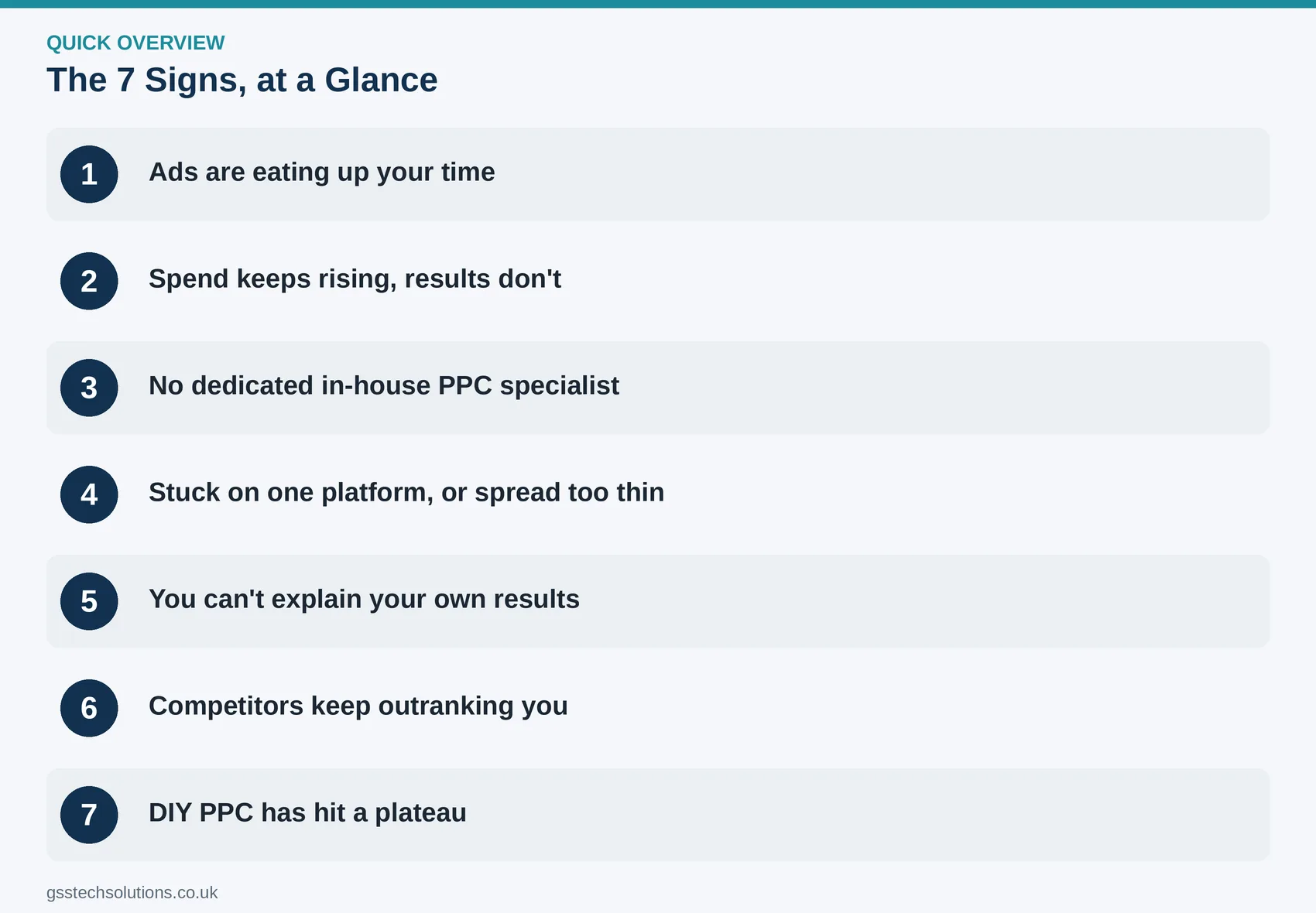
7 Signs Your Business Needs a Paid Media Agency
Not every business needs outside help with paid media, but certain patterns show up again and again in businesses quietly losing money to inefficient campaigns. Here are seven of the clearest ones.
1. Your Team Is Spending More Time Managing Ads Than Running the Business
If the person running your paid campaigns is also meant to be running operations, managing staff, or serving customers, ads get whatever time is left over, which isn’t much. PPC campaign management isn’t a task you finish once. Bids need adjusting, weak keywords need pausing, and new opportunities need testing continually.
Try this first: Track how many hours you or your team spend on ads in a typical week, including time spent worrying about them. If it’s eating into time that should go toward paying customers, that’s usually your answer.
2. Your Ad Spend Is Increasing, but Results Aren’t
Costs creeping up while enquiries or sales stay flat is one of the most common reasons businesses start looking for a paid media agency. It’s rarely bad luck. It’s usually a symptom of broad targeting, a thin negative keyword list, or a bidding strategy set up once and never revisited.
Try this first: Pull up your search terms report and look for irrelevant queries your ads are showing for. A handful of negative keywords is often enough to stop obvious waste before you tackle the bigger strategy.
3. You Don’t Have a Dedicated Digital Marketing Specialist In-House
Someone in the business is probably doing the marketing alongside three other jobs, fine for social posts and the odd newsletter. Paid media rewards specialist knowledge: auction mechanics, conversion tracking, audience segmentation, and a feel for how each platform’s algorithm rewards advertisers. That experience is hard to replicate from tutorials alone.
Try this first: List everything a competent digital marketing specialist should own, from tracking setup to bid strategy to creative testing. If nobody in your business could confidently tick every box, that’s a real gap, not a reflection on anyone’s effort.
4. You’re Only Advertising on One Platform, or Not Sure Which to Use
Plenty of businesses start with Google Ads because it feels obvious, then never expand, even when customers are clearly active elsewhere. Others run campaigns everywhere at once, spreading a small budget so thin that nothing gathers enough data to work properly. Search, social, and marketplace platforms all reward different types of buying intent.
Try this first: Map out where your customers actually spend their time online before adding a new platform. A well-run single channel almost always beats three half-managed ones.
5. You Can’t Confidently Explain Your Own Campaign Performance
If a colleague asked you to explain, in plain English, whether last month’s ad spend made the business money, could you do it in under two minutes? Many owners can quote a click-through rate or cost per click but struggle to connect those numbers to actual revenue, which is exactly what proper PPC campaign management should fix.
Try this first: Ask whoever manages your ads to walk you through last month’s results using only pounds spent, leads generated, and cost per lead. If the conversation drifts into vanity metrics instead, your reporting needs work.
6. Competitors Keep Outranking and Outbidding You
You search for your own product or service and see the same two or three competitors in the paid slots every time, while your ad is nowhere to be found. That isn’t always about a smaller budget. It’s often Quality Score, ad relevance, and landing page experience- factors that reward a well-optimised paid search agency approach over simply outspending everyone.
Try this first: Search your top three keywords from a private browser window and note who appears consistently. That’s your real competitive floor, not just the businesses you already think of as rivals.
7. You’ve Tried DIY PPC and Hit a Plateau
Plenty of businesses get campaigns off the ground, see early results, then stall. You’ve tried new ad copy, adjusted the budget, maybe switched bidding strategies, and nothing moves the needle anymore. That plateau doesn’t mean paid media has stopped working. It usually means you’ve reached the edge of what trial and error can achieve alone.
Try this first: Look back at your last three genuine tests. If none produced a clear result either way, that’s often a sign you need fresh expertise, not more guesswork.