What your Google Ads marketing agency needs to disclose
There is no official agency checklist yet, so this is our recommended standard, drawn from the rules above. Whichever PPC advertising agency you use, you should be able to get these seven answers in writing.
Table 2: Seven Disclosure Questions For Your Google Ads Marketing Agency |
|---|
What to ask | What good looks like |
|---|
Which assets used AI? | A list by campaign covering images, video, voice, copy and feeds |
Which tools were used? | Tool names, plus confirmation that licence terms allow commercial use |
Do synthetic people or voices appear? | A clear yes or no, and confirmation that none is passed off as a real customer |
Who checked the claims? | A named human reviewer who verified prices, results and product accuracy |
Was the AI content label applied? | Screenshots showing the setting in your Google Ads account |
Was your data put into AI tools? | Confirmation that customer data was handled under UK GDPR |
Where are the original files? | Source files and prompts stored in case a complaint arrives |
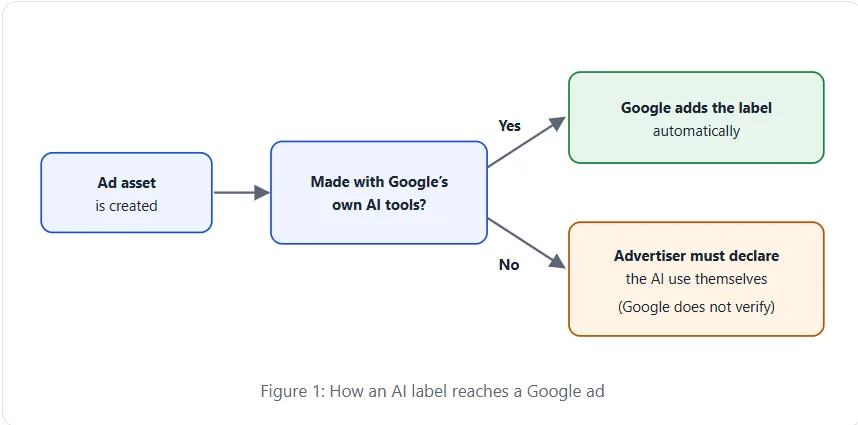
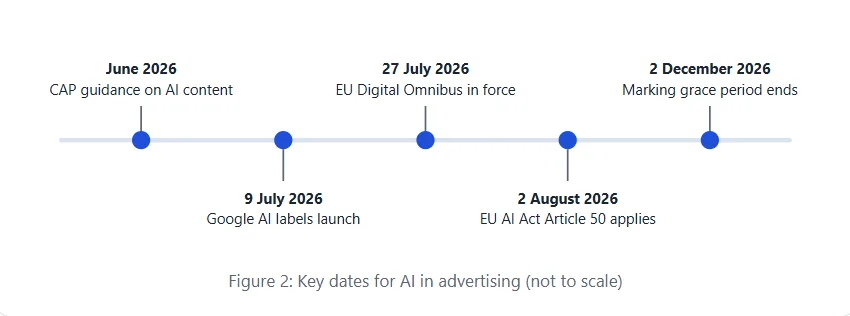
Automated features deserve a mention. Google labels assets created by its own tools, but your Google Ads marketing agency should still tell you which automated asset features are switched on in your account, so nothing is generated without your knowledge.
Practical examples: when disclosure matters
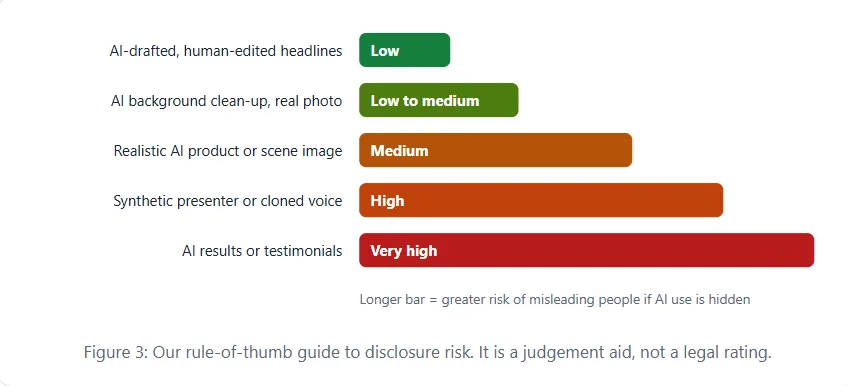
As a rule of thumb, the more realistic and persuasive the AI content, the higher the disclosure risk.
The skincare “results” image
A clinic uses an AI image to show smoother skin after treatment. Even with a disclosure, the picture overstates what customers can expect, which is the problem CAP’s own example describes. Use real, representative results instead.
The synthetic customer
A local business asks for a video of a happy customer, generated entirely by AI. Presenting a synthetic person as a real client is deceptive and may breach fake review rules. If you use a synthetic presenter, say so and never call them a customer.
The tidied-up photo
A plumber’s real job photo has its background cleaned with AI. The scene still shows genuine work, so the risk is low. Note it in your usage log and declare it if the edit is material.
The AI-drafted headline
Responsive search ad headlines drafted with AI and edited by a human are low risk today. Log them anyway, because the policy scope is broad and still developing.
A practical checklist for advertisers
Use this list when briefing or reviewing any Google Ads marketing agency.
Put it in writing. Add an AI clause to your contract covering tools, approvals and disclosure duties.
Request an AI usage log. Ask for a running record by campaign, updated whenever creative changes.
Check the label setting. Ask for screenshots confirming third-party AI assets were declared.
Substantiate every claim. Prices, results and reviews must be true and provable, however the ad was made.
Never fake people or proof. No invented customers, testimonials or before-and-after images.
Keep the originals. Store source files, prompts and approvals so you can respond quickly to a complaint.
Review every quarter. Google, CAP and EU guidance are all moving, so revisit your policy regularly.
Red flags when choosing a PPC advertising agency
Vague answers about which tools are used
No named person who approves creative
Promises of fast, cheap creative with no review step
Reluctance to share what was AI-generated
Frequently Asked Questions
Do I have to label every AI-generated ad in the UK?
No. There is no blanket UK requirement. The test is whether leaving out AI use would mislead your audience, and whether a disclosure would clarify or contradict your message. Many advertisers choose to disclose prominent, realistic AI content anyway, because it builds trust.
Is Google AdWords the same as Google Ads?
Yes. Google AdWords was renamed Google Ads in 2018. The platform now covers Search, YouTube, Display, Shopping, Performance Max and more, which is why AI-made creative can appear in so many places.
Will Google reject my ads if I forget to declare AI use?
Google has said it will not independently verify third-party declarations, and it has not added a separate approval step for AI-made ads. That is not permission to skip it. Misleading ads remain prohibited, responsibility stays with you, and local laws may still require disclosure.
What should a PPC advertising agency’s AI policy include?
It should name the tools used, explain when AI content is declared, require human review of claims, set rules against synthetic testimonials, and describe how records are kept. Ask to see it before you sign.
Does the EU AI Act affect a UK business?
It can. If your AI-generated content reaches people in the EU, Article 50 duties on deepfakes and public-interest text may apply to you. Speak to a solicitor about your specific campaigns.
Does AI-written ad copy need a label?
Text-only AI use is generally seen as lower risk today, but the policy scope is broad and still evolving. Declare AI copy when its role is material, and log it either way.
Final Words
AI is not the problem. Hidden AI is. Google’s new labels, the CAP Code and the EU AI Act all point the same way: tell people how your ads were made, and never let AI stretch the truth. The strongest Google Ads marketing agency relationships are built on written policies, honest records and human judgement.
Not sure what your current agency is doing? Ask the seven questions above, then compare the answers. If you would like a clear, jargon-free review of your Google Ads account and its AI use, contact GSS Tech Solutions on 0203 599 8122 or explore our paid advertising services.