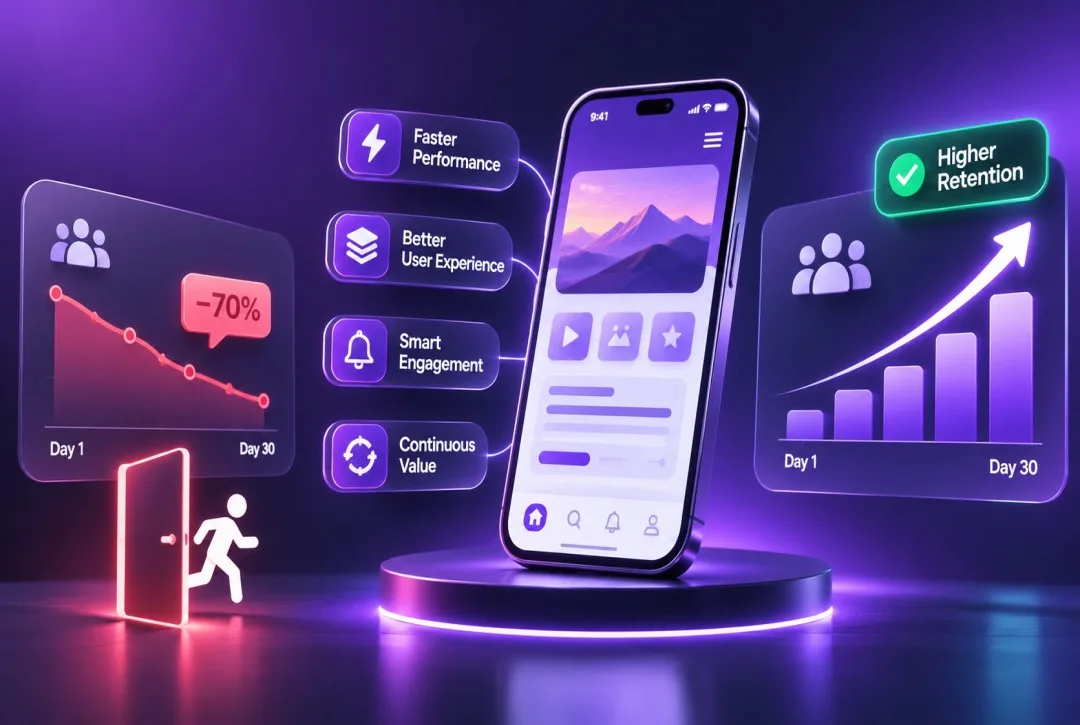
You launch your app. Downloads climb, the team celebrates, and the first week looks healthy. Then, around week three, the graph tells a different story: most of those new users have quietly stopped opening it.
If that sounds familiar, you are in good company. One 2026 analysis found that more than 90% of mobile app users abandon an app before day 30. That does not mean your idea is weak. Usually, a handful of fixable problems in onboarding, performance and notifications are to blame. Those are exactly the areas where well-run mobile app development services make the biggest difference.
In this article, we explain why people leave within a month, how a good mobile app agency designs for retention from the start, and what you can do over the next 30 days to keep more of the users you have already paid to acquire.
Quick takeaways
Day 30 retention is low across the board, so compare yourself with your own category.
Most early churn traces back to onboarding, stability and notifications.
Retention is built through discovery, design, engineering, testing and post-launch care.
How Bad Is the 30-Day Drop-Off?
Steep, and it begins on day one. A 2026 benchmark roundup puts average iOS retention at 25.4% on day one, falling to 5.3% by day 30, while Android slides from 20.2% to 3.8%. The same source reports a global day 30 average of 7%, with subscription apps doing better at 14%.
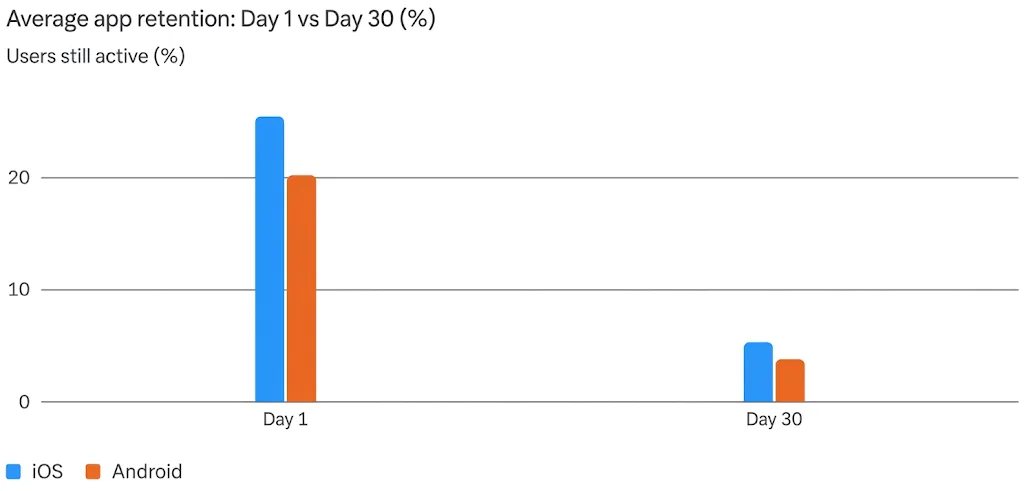
Figures vary with how you measure. AppsFlyer data, reported by Sendbird, found that 53% of users uninstall an app within 30 days of downloading it. The gap between that figure and the 90% above is probably users who stop opening the app without deleting it. Either way, the first month decides whether your app becomes a habit or a forgotten icon.
Table 1: Retention benchmarks at a glance
Metric | Average |
|---|---|
iOS, day 1 | 25.4% |
iOS, day 30 | 5.3% |
Android, day 1 | 20.2% |
Android, day 30 | 3.8% |
All apps, day 30 (global) | 7% |
Subscription apps, day 30 | 14% |
Finance apps, day 30 | 4.2% |
Two points are worth remembering. First, day 30 benchmarks run from roughly 1% to 15% depending on category and platform, so judge yourself against similar apps and your own cohort trend. Second, day 3 behaviour is one of the earliest predictors of long-term retention, so the first 72 hours deserve most of your attention.
Why Users Leave Within 30 Days
Every app is different, but the same five causes appear again and again.
1. They never reach the "aha" moment
Users who install but never complete onboarding or reach the product's core value tend to uninstall quickly, and this sits alongside crashes and notification overload as a leading cause. Roughly a quarter of downloaded apps are opened only once. If sign-up asks for six fields before showing anything useful, you are requesting trust you have not yet earned.
2. The app is slow, unstable or hungry
Crashes, freezing and slow loading wear down confidence fast. In one survey, 11% of users removed an app because of technical problems, and around 20% delete apps to free up storage. Heavy apps that drain the battery are first in line.
3. Notifications become noise
Notification fatigue ranks among the top uninstall drivers. Generic daily pushes teach people to switch alerts off or delete the app entirely.
4. Sign-up and permissions create friction
Apps that request excessive permissions without explaining why make users wary. Asking for location, contacts and notifications on the very first screen is a classic mistake.
5. There is no reason to come back
Even a well-built app loses people if week one feels identical to week three. Without fresh content, useful reminders, new features or visible progress, nothing pulls users back.