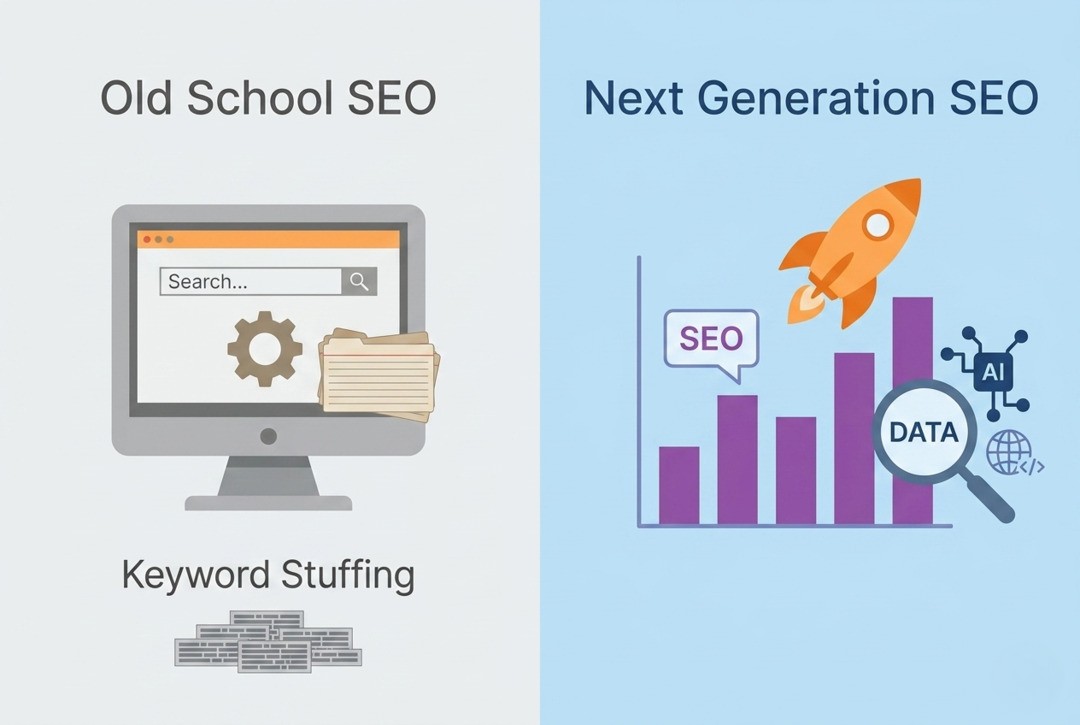
Traditional SEO tactics focused on keyword rankings and backlinks are no longer enough. The top SEO company in UK is now pivoting to AI search optimisation and Generative Engine Optimisation (GEO); restructuring content strategy, technical SEO, and local SEO to stay visible in AI-generated answers, not just search result pages.
The rules of search have changed. Not gradually, but sharply. Google’s AI Overviews now appear at the top of millions of search results pages, answering users’ questions before they ever click a link. ChatGPT, Perplexity, and Microsoft Copilot are becoming the first stop for millions of users seeking recommendations, comparisons, and advice.
For businesses relying on organic search traffic, this shift is significant. And for every top SEO company in UK, it raises an urgent question: how do you stay visible when the search engine is no longer just ranking pages, it’s summarising them?
What Has Changed About Search in 2026
Search engines have always rewarded relevance. What’s changed is how relevance is measured and where results are displayed.
Google’s AI Overview feature pulls content directly from web pages to generate summary answers. Users see those answers instantly, often without clicking through to any source. AI Overviews now appear in a significant number of all Google searches in the UK, and the figure is climbing.
Generative Engine Optimisation (GEO) is the emerging discipline that addresses this shift. Where traditional SEO focuses on ranking in the ten blue links, GEO focuses on being cited, quoted, or surfaced within AI-generated responses. The two approaches are related, but they require different techniques.
How AI Engines Map Topic Authority
AI search engines do not assess authority from a single page alone. They look at how well a brand, author or website covers a subject across multiple connected pieces of content. Instead of asking, “Does this page contain the right keyword?”, AI engines are increasingly asking, “Is this source genuinely knowledgeable about this topic?”
This means topic authority is built through depth, consistency and contextual relevance. A top SEO company in UK can no longer rely on isolated blog posts targeting individual keywords. It must help businesses create clear topic clusters that answer related questions, explain core concepts, address buyer concerns and demonstrate real-world expertise.
For example, a law firm writing one article on “employment law advice” may struggle to appear authoritative. But a firm with detailed content on unfair dismissal, redundancy, workplace disputes, settlement agreements, employer obligations and employee rights sends much stronger signals to AI-driven search systems.
AI engines also map authority by identifying entities. These include brands, people, services, locations, industries and specialist terms. When these entities are consistently connected across a website, third-party platforms, reviews, citations and expert mentions, AI systems can better understand what the business is known for.
In the age of generative search, authority is no longer just about ranking one page. It is about becoming a trusted source that AI engines can confidently cite, summarise or recommend.
What a Top SEO Company in UK Must Know
The leading agencies aren’t abandoning SEO fundamentals; they’re extending them. Here’s how the most forward-thinking teams are adapting across three core areas.
How Is Content Strategy Evolving for AI Search
The biggest change is in how content is structured, not just what it covers.
AI systems favour content that is specific, well-organised, and easy to extract. Vague and padded articles that used to rank on keyword volume alone are increasingly invisible to generative engines. Top SEO company in UK responds by:
- Writing answer-first content. Rather than building to a conclusion, high-performing content now opens with a direct, concise answer to the reader’s question. It mirrors how AI systems prefer to retrieve and surface information.
- Using structured subheadings. Headers phrased as specific questions (e.g., “How long does technical SEO take to show results?”) are more likely to be matched against conversational queries in AI tools.
- Prioritising fact density. Named sources, specific statistics, and cited data are weighted more heavily by AI systems than general assertions. Content backed by verifiable claims builds the kind of authority that generative engines trust.
The practical upshot: a leaner, more direct content strategy tends to outperform longer, keyword-stuffed articles; both in traditional search and in AI-generated responses.
What Role Does Technical SEO Play in AI Visibility
Technical SEO has always been the foundation of organic visibility. In an AI-driven search environment, it becomes even more critical because if a site can’t be crawled and understood efficiently, it won’t be cited.
The areas drawing the most attention from a top SEO company in UK right now include:
- Structured data and schema markup. Schema helps search engines and AI systems understand what a page is about, who wrote it, and what entities it references. Implementing Article, FAQ, and How-To schema increases the chance of content being surfaced in AI Overviews.
- Site speed and Core Web Vitals. Fast, stable pages are more likely to be indexed thoroughly and ranked consistently, a baseline requirement for AI citation.
- E-E-A-T signals. Google’s framework of Experience, Expertise, Authoritativeness, and Trustworthiness has taken on new weight. AI systems are trained to favour content from credible, well-established sources. Technical SEO now includes ensuring author credentials, brand mentions, and entity associations are clearly signalled across a site.
How Is Local SEO Changing in the Age of Generative Search
Local SEO presents a specific challenge. When a user asks an AI tool, “which is the best accountant near me?” or “find a plumber in Manchester,” the answer increasingly comes from AI, not from a traditional map pack or local listing.
Established best practice still matters: a complete and accurate Google Business Profile, consistent NAP (name, address, phone) data across directories, and a steady flow of genuine customer reviews. But the top SEO company in UK is going further.
They’re optimising for the conversational queries that local users are now posing to AI tools. That means creating locally specific content such as area pages, FAQ sections addressing local queries, and content that names the communities, landmarks, and services relevant to each location. The goal is to build enough local authority that generative engines cite the business when answering location-based queries.
Why AI Rewards Original Data and Penalises Commodity Content
AI search has made generic content easier to detect and less valuable. Pages that simply repeat common advice, rewrite competitor articles or provide surface-level definitions are less likely to stand out in generative results. This type of content is often called commodity content because it offers nothing unique.
AI engines are designed to provide users with direct, useful and confident answers. To do that, they prefer content that adds something new to the conversation. Original data, expert insights, case studies, first-hand experience, proprietary research and real examples all help distinguish a business from competitors.
Commodity content, on the other hand, is becoming weaker because AI can already summarise general knowledge without needing to send users to another website. If a page only explains what hundreds of other pages already say, it provides limited value.
A strong AI search strategy should therefore focus on originality. Businesses should ask: “What can we say that our competitors cannot?” The answer may come from customer experience, internal data, specialist knowledge, local insight or proven results.
A top SEO company in UK understands that in Generative Engine Optimisation (GEO), the most valuable content is not the content that says the most. It is the content that contributes something distinctive, credible and useful.
Is Traditional SEO Still Worth Investing In
Yes. Backlinks, keyword research, and on-page optimisation still influence rankings. Google hasn’t replaced its core algorithm; it has layered AI features on top of it. A site that performs poorly in traditional search will also struggle to be cited by AI systems, because both rely on similar authority signals.
The practical recommendation from most top SEO companies in the UK is not to choose among traditional SEO, GEO, and AEO, but to align them. Content strategy, technical SEO, and local SEO should all be updated to serve both audiences: human users clicking through search results, and AI systems scanning for citable, trustworthy content.
What Should UK Businesses Do Right Now
The businesses best positioned for the next phase of search are those acting now, not waiting for the landscape to stabilise. Three concrete starting points:
- Audit your existing content for answer-readiness. Does each key page open with a direct, specific answer to the question it targets? If not, restructure it.
- Implement or update schema markup. Work with your SEO provider to ensure structured data is in place across your most important pages.
- Review your local SEO footprint. Check that your business information is consistent, your Google Business Profile is complete, and your site includes content that speaks directly to your local audience.
What is Answer Engine Optimisation (AEO)?
Answer Engine Optimisation (AEO) is the highly targeted practice of structuring digital content so that AI-powered platforms can instantly extract it and deliver it as a direct, single answer to a user’s query. While traditional SEO optimises for Search Engine Results Pages (SERPs) and GEO optimises for complex generative summaries, AEO focuses specifically on the immediate “retrieval layer.”
What is Generative Engine Optimisation (GEO)?
Generative Engine Optimisation (GEO) is the practice of structuring and presenting web content so that AI-powered search tools such as Google AI Overviews, ChatGPT, and Perplexity are more likely to cite, quote, or surface it in their generated responses. GEO builds on traditional SEO principles but adds a focus on answer-first formatting, fact density, and structured data.
How is GEO different from traditional SEO?
Traditional SEO focuses on ranking pages in search engine results. GEO focuses on being cited within AI-generated answers, which often appear before any ranked results. Both share common foundations such as authority, relevance, and technical quality, but GEO requires content to be more directly structured, fact-dense, and clearly attributed.
Does a top SEO company in UK offer GEO services?
The leading agencies are increasingly incorporating GEO into their service offering, either as a standalone service or as part of broader content strategy and technical SEO packages. When evaluating an agency, ask specifically whether they optimise for AI Overviews and generative search, not just traditional keyword rankings.
Is local SEO still relevant for AI search?
Yes. Local SEO remains essential, but the tactics are expanding. In addition to Google Business Profile optimisation and consistent directory listings, businesses now need locally specific content that addresses the conversational queries local users are posing to AI tools. Agencies with strong local SEO experience are adapting these practices for generative search.
How quickly can GEO improvements produce results?
GEO results can vary. Structural content changes such as answer-first formatting and schema markup can influence AI citation within weeks of re-indexing. Building the broader authority signals that generative engines prefer (E-E-A-T, backlinks, brand mentions) is a longer-term effort, typically measured in months.
Final Words
Search isn’t disappearing, it’s evolving into something that combines traditional indexing with AI-powered synthesis. The top SEO company in UK has accepted that optimising for AI citation is now as important as optimising for keyword rankings.
For UK businesses, the message is straightforward. The agencies worth working with are those already versed in GEO, structured content strategy, and the technical SEO requirements of AI search, not those still relying on tactics from five years ago.
Are you looking for the top SEO company in UK? Just connect with us to avail professional SEO services at affordable rates.