London has more web development agencies than almost any other city in Europe, which is exactly the problem. Search for web development London and you will be met with thousands of studios, freelancers and full-service agencies, all promising the same things: sharp design, clean code and results. For a business owner trying to choose a partner for a new site or a custom web application, that much choice can feel less like freedom and more like noise.
Here’s the good news. The best web development agencies in London do not all look the same on paper, but they do share the same handful of habits. Some specialise in sleek brochure sites for local businesses. Others build complex web applications for logistics firms, healthcare providers or financial services companies. What separates the agencies genuinely worth hiring from the ones with just a nice portfolio page comes down to a few specific, checkable things, not marketing language.
This article breaks those things down in plain English. We will look at what actually sets strong web development agencies in London apart, how much you should expect to pay, the real difference between web design, web development and web applications, and the questions worth asking before you sign anything.
Why London’s Web Development Market Is So Crowded
London is home to one of Europe’s largest concentrations of digital agencies, software houses and freelance developers, ranging from single-person consultancies to enterprise-grade firms working with major national brands. That density brings real advantages for businesses doing the hiring, with no shortage of specialist experience nearby, whether you need a straightforward WordPress site for a local trades business or a custom web application for a growing fintech.
It also keeps standards high. Agencies that last in London tend to do so because they have built a repeatable process, not because they got lucky with one big client. That is worth remembering when you compare options: a long track record and a consistent, varied body of work usually says more than a flashy homepage.
Quick stat: Over 70% of UK web browsing now happens on a mobile device, so an agency still designing desktop first is already behind. A portfolio from three or four years ago will not tell you much about how an agency builds today. |
What Sets the Best Web Development Agencies in London Apart
Strip away the marketing copy and the agencies that consistently deliver strong results tend to share the same handful of traits. Here is what to actually look for.
A Structured, Transparent Process
The best agencies do not jump straight into design software. They start with discovery, taking time to understand your business goals, your audience and what the site or application genuinely needs to do. That is typically followed by planning and architecture, wireframing, design, development, testing, and a proper deployment and support plan. If an agency cannot describe its process in a few clear steps, that is usually a sign it does not really have one.
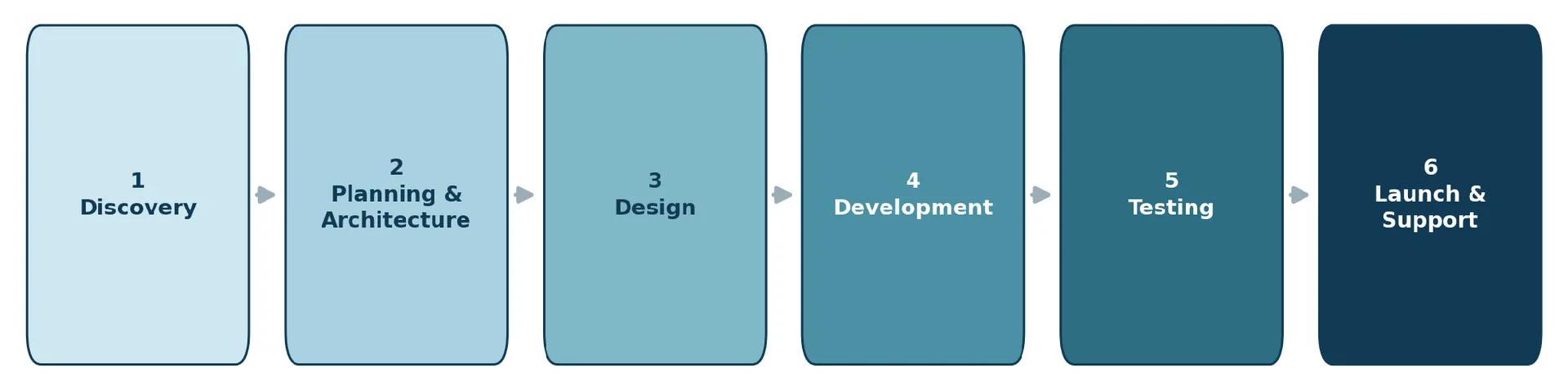
A typical structured web development process, from discovery through to post-launch support
Genuine Technical Depth Across Web Applications
Web development London covers a huge amount of ground, from a five-page brochure site to a fully featured web application with logins, dashboards and payment processing. Strong agencies are comfortable across several frameworks (React, Next.js, Node.js and WordPress are all common in London) rather than pushing every client towards the one platform they happen to know best. Ask what they would recommend for your specific project and why. A good answer references your requirements, not just their favourite tool.
SEO-Friendly Development From the Ground Up
A beautiful website that nobody finds is not much use to anyone. The best web development agencies in London build with search performance in mind from day one: clean code, fast load times, sensible heading structure, mobile responsiveness and accessible markup. Retrofitting SEO onto a badly built site afterwards is far harder, and usually more expensive, than getting the foundations right the first time.
Security, Compliance and Accessibility Credentials
This is one of the more overlooked differentiators. Certifications such as ISO 27001 for information security, Cyber Essentials Plus, and genuine attention to WCAG accessibility guidelines and the Equality Act are not just box-ticking exercises. They show an agency has processes in place to protect client data and to build sites that work for disabled users, both of which matter more each year as UK expectations and regulation tighten.
A Portfolio You Can Actually Verify
Screenshots on an agency’s own website are easy to dress up. Live links, case studies with real outcomes, and reviews on independent platforms such as Google, Trustpilot, Clutch or GoodFirms are much harder to fake. Before hiring anyone, click through to two or three live projects and test them yourself on a phone, not just a laptop.
Support That Does Not End at Launch
Websites and web applications need ongoing maintenance: security patches, plugin updates, performance monitoring and the occasional emergency fix. Agencies worth hiring are upfront about what happens after launch, including realistic response times and exactly what is, and is not, included in ongoing support.
Web Design vs Web Development vs Web Applications
These three terms get used interchangeably, which causes real confusion when briefs are written or budgets are set. They are not the same thing, and knowing the difference will help you brief any agency far more accurately.
Term | What It Actually Means | A Typical Example |
|---|---|---|
Web design | The visual layout, branding and user experience of a site | Colour palette, typography, page layout, navigation |
Web development | The coding and technical build that makes a site function | Front-end code, back-end logic, database integration |
Web application | Interactive, software-like functionality that runs in the browser | Booking systems, client portals, dashboards, logins |
Web design is about how a site looks and feels: the layout, colour palette, typography and overall user experience. Web development is the technical build that brings that design to life, including the front-end code visitors interact with and the back-end systems running behind the scenes. A web application goes a step further again. Rather than a mostly static set of pages, it is interactive software that runs in the browser, think booking systems, client portals or dashboards, anywhere a user logs in and the content changes based on what they do.
Most business websites need strong web design paired with solid web development London. Not every business needs a full web application, and paying for one you do not actually need is one of the most common ways a budget gets wasted.
How Much Does Web Development Cost in London?
Pricing is one of the most common questions business owners ask, and one of the hardest to answer with a single figure, because so much depends on scope, features and how much content already exists. As a general guide for 2026:
Provider Type | Typical Price Range | Best Suited For |
|---|---|---|
Freelance developer | £500 to £5,000 | Simple sites with a well-defined, limited scope |
Small or boutique agency | £1,500 to £15,000 | SME websites and brand-focused builds |
Full-service agency | £8,000 to £50,000 | Custom web applications, e-commerce, ongoing growth |
Enterprise agency | £50,000 and upwards | Large organisations with complex integrations |
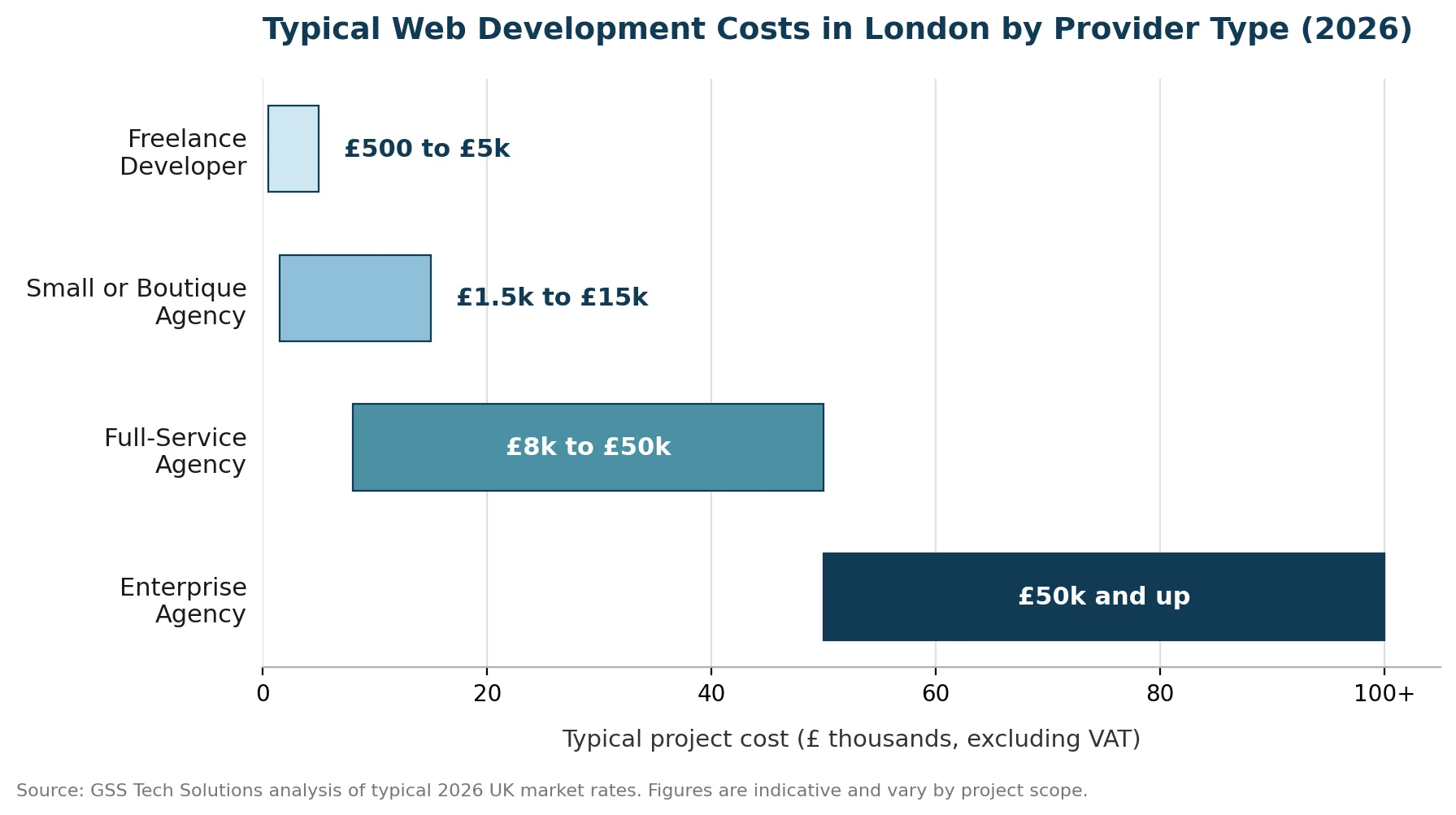
These figures are typically quoted exclusive of VAT, and the final number depends heavily on the number of pages, any custom functionality, e-commerce requirements, and how much content needs writing or migrating. A useful rule of thumb: the more a business depends on its site to generate revenue directly, through bookings, sales or lead capture, the more it is worth investing in getting it right the first time.
How to Choose the Right Web Development Agency in London
Start with your goals, not features. Before contacting anyone, write down what the site needs to achieve, more enquiries, online sales, fewer support calls, and judge every proposal against that list.
Ask about their tech stack, and why. A confident agency will explain why it would use a particular framework for your project rather than defaulting to whatever it always uses.
Request live examples, not screenshots. Ask for two or three links to sites the team has actually built, then test them yourself on both desktop and mobile.
Check reviews across more than one platform. Google, Trustpilot, Clutch and GoodFirms each tend to attract slightly different reviewers, so checking more than one gives a fuller picture.
Clarify ownership and support terms before signing. Confirm who owns the code, domain and design files once the project ends, and get post-launch support terms in writing.
Get an itemised quote. A single lump-sum figure with no breakdown makes it hard to know what you are actually paying for, and even harder to control costs if the scope changes later.
Red Flags Worth Watching For
Not every agency in London operates the way it should. A handful of warning signs are worth taking seriously:
No live examples of past work, or a portfolio full of near-identical templated sites
Reluctance to share client references or point you towards independent reviews
A quote with no breakdown of what is actually included
No clear answer about what happens after launch
Promises of guaranteed first-page Google rankings (no honest agency can guarantee this)
Frequently Asked Questions About Web Development London
How much does it cost to build a website in London?
Most small business websites in London cost somewhere between £1,500 and £15,000, depending on design complexity and functionality. Custom web applications with features such as logins, payments or dashboards typically start higher, often from £15,000 upwards. Always ask for an itemised quote so you know exactly what is included before you commit.
How long does a typical web development project take?
A straightforward brochure website usually takes four to eight weeks from discovery to launch. More complex builds, such as e-commerce platforms or custom web applications, commonly take three to six months, depending on the number of features involved and how quickly content and feedback are provided.
What is the difference between web design and web development?
Web design covers the visual and user experience side of a site: layout, colours, typography and navigation. Web development is the technical build, the actual code, that makes that design function as a working website or web application.
Do I need a website or a full web application?
If visitors mainly need to read information and get in touch, a well-built website is usually enough. If users need to log in, book something, manage an account or interact with real-time data, you likely need a web application, which involves more development time and a larger budget.
Is it worth paying more for a London-based agency over a remote or offshore team?
It depends on your priorities. London agencies typically charge more, reflecting higher operating costs, but they offer easier face-to-face collaboration, no time zone friction, and closer familiarity with UK-specific rules such as accessibility law and GDPR. Offshore teams can offer lower rates but usually need more careful project management to get the same result.
How can I tell if a web development agency is trustworthy?
Look for independently verifiable signals: live case studies, reviews spread across multiple platforms, relevant certifications such as ISO 27001 or Cyber Essentials, and a clear, structured process the team can explain without hiding behind jargon. Agencies that stay vague about any of these are worth treating with caution.
Final Words
There is no single “best” agency for web development London, only the best one for what you specifically need. A start-up building its first web application has different priorities from an established retailer that simply wants a faster, more accessible website. What matters is applying a consistent set of criteria, process, technical range, security credentials, verifiable results and genuine post-launch support, to compare your options properly, rather than choosing on price or first impressions alone.
If you are currently weighing up your options for web development London, GSS Tech Solutions works across website development, web applications and e-commerce for businesses of all sizes.
Get in touch for a free, no-obligation quote at gsstechsolutions.co.uk or call 0203 599 8122.