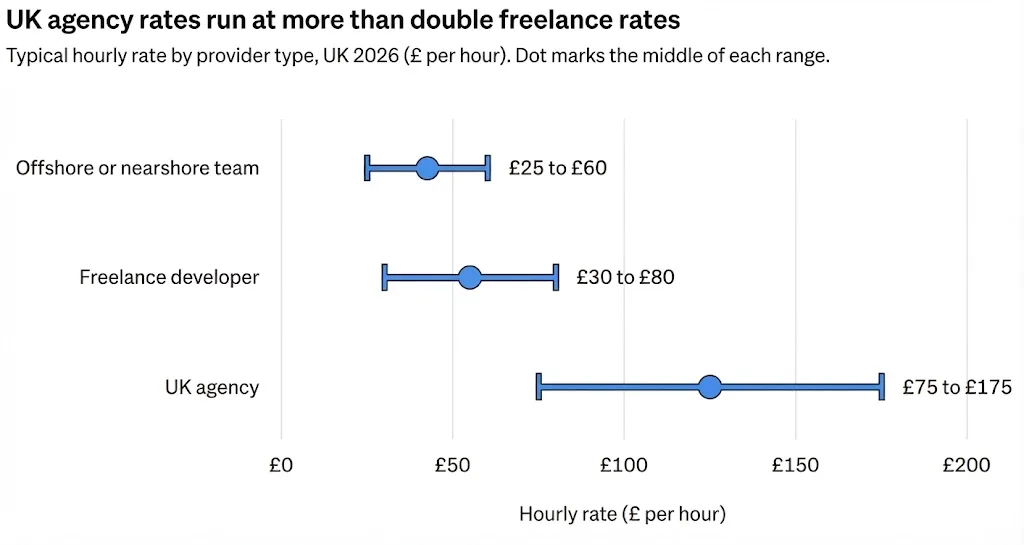
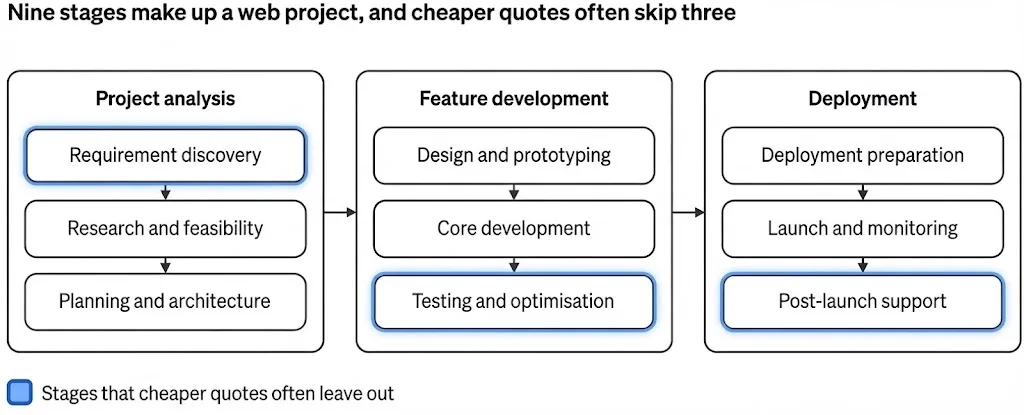
How You Pay for Web Development Services
The billing model changes who carries the risk, so it is worth choosing deliberately.
Fixed price suits a well-defined scope, such as a brochure site. You know the total upfront, but changes usually cost extra.
Time and materials suits projects that will evolve, such as web applications. You pay for hours worked, so budget control depends on regular reporting.
Retainer suits ongoing improvement after launch. You buy a set amount of capacity each month, which works well for SEO, new features and maintenance.
Many projects combine two of these: a fixed-price build followed by a monthly retainer. Our guide to retainer versus project-based engagement explains how to decide.
The Costs After Launch That Quotes Often Miss
Your build fee is only the entry ticket. A live website has running costs, and they are worth planning before you sign.
Ongoing cost | Typical UK range | Notes |
Domain name | £10 to £50 a year | Varies by extension and registrar |
Hosting | £5 to £15 a month (shared) or £20 to £50 a month (managed) | Business-critical sites suit managed hosting |
SSL certificate | £0 to £100 a year | Often included with quality hosting |
Maintenance and support | £40 to £100 a month | Busy or e-commerce sites often pay £120 or more |
SEO (optional) | From £500 a month | Depends heavily on your competition |
Here is a worked example. Take a £5,000 website with managed hosting at £25 a month, maintenance at £75 a month and a £15 domain. Over three years, running costs add £3,645, so the real three-year cost is £8,645.
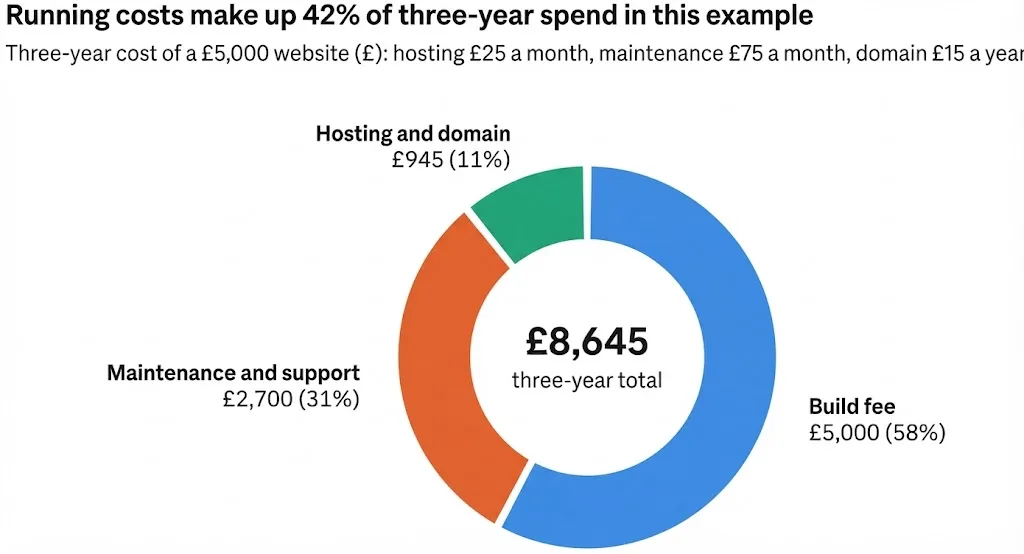
Remember VAT too. Agency quotes usually exclude it, and the standard rate is currently 20 per cent. VAT-registered businesses can usually reclaim it.
Three Practical Examples
These are illustrative budgets rather than price lists, but they show how the ranges work in practice.
A Local Trades Business
Imagine a plumber who wants eight pages, an enquiry form, click-to-call buttons and local search foundations. That is a professional business website, typically £3,000 to £6,000, plus £60 to £80 a month for hosting and care. Say the site brings ten extra enquiries a month, the business closes a quarter of them, and each job earns £800 gross profit. That is about £2,000 a month, so even at the top of the range the site pays for itself in around three months.
An Online Shop
A retailer with 300 products, discount codes, shipping rules and stock syncing usually spends £8,000 to £25,000 on a platform such as Shopify or WooCommerce, and more if it needs custom warehouse integrations. GSS Tech Solutions builds on Shopify, Magento, WooCommerce and custom platforms, so the platform follows your catalogue and growth plans rather than the other way round.
Our work on business energy platforms such as SwitchUrEnergy shows how quickly scope grows. A comparison platform needs quote workflows, live supplier data, secure contract generation and an admin back end, not just attractive pages. Projects like this sit in the web application bands, starting around £12,000 and rising with the number of user roles and integrations.
Eight Ways to Get Better Value From Your Budget
Write a one-page brief covering your goals, audience, must-have features and nice-to-haves.
Launch a lean first version, then add features in phases.
Get at least three quotes, and ask for each one to be itemised.
Compare like for like: the same pages, the same features and the same support.
Ask who owns the code, design files and domain when the project ends.
Test live projects on your phone and read independent reviews on Google, Trustpilot and Clutch.
Prepare copy and images early, because late content causes delays and extra fees.
Hold back a contingency of 10 to 15 per cent for changes you discover along the way.
Frequently Asked Questions
How much do web development services cost for a small business in the UK?
Most small businesses pay £1,500 to £6,000 for a professionally designed site. If you need fully custom design, a richer content management system and stronger SEO foundations, budget £3,000 to £15,000. Template-only builds can start below £1,500. It is noted that these are average rates that can vary as per the complexity and scope of the project.
Is web design cheaper than web development?
Not necessarily. On custom projects, development usually takes more hours than design, but the two work together. Strong web design on weak development looks good and performs badly. Most agencies quote them as one package.
How much do web applications cost compared with websites?
Web applications cost more because they need user accounts, databases, security, integrations and heavier testing. Expect £12,000 to £80,000 for most business builds, with complex platforms above that.
How long does a web development project take?
A professional business website usually takes four to twelve weeks. E-commerce stores commonly take two to four months, and web applications three to nine months. Late content and slow sign-off cause most delays.
Are ongoing costs really necessary?
Yes. Without updates, backups and monitoring, sites become slow, insecure and eventually broken. Budget £50 to £200 a month for hosting and maintenance on most business sites.
Should I choose the cheapest quote?
Rarely. Ask what is missing. Discovery, testing, accessibility checks, training and support are the usual gaps, and a quote that leaves them out often costs more in the end.
Final Words
There is no single price for web development services in the UK, but there is a sensible way to arrive at yours. Define what the site must achieve, match it to the right band, add running costs and VAT, and compare quotes like for like. Spend where the site earns its money: clear web design, solid development and support after launch. Be wary of savings that skip testing or security.
At GSS Tech Solutions, we build websites, e-commerce stores and web applications for UK businesses from our offices in London and Leeds, backed by ISO 27001 and Cyber Essentials Plus certification. Share your requirements, and we will send you a free quote. Get your free quote or call 0203 599 8122.