Five Ways AI Is Genuinely Changing Web Development London
Rather than treating AI as one big idea, it helps to break down where it is actually earning its place in a typical web development project today.
1. Faster Wireframing and Prototyping
Before a single line of code gets written, a project starts with wireframes and rough layouts. AI-assisted design tools can now generate several layout options from a short brief or a set of reference sites within minutes rather than days. This does not replace a designer's eye, but it gives a London web design team more starting material to react to, compare, and refine with the client in the room.
2. AI-Assisted Coding, Not AI-Only Coding
AI coding assistants and code completion plugins have become a normal part of a developer's toolkit, suggesting functions, catching obvious bugs, and writing repetitive boilerplate so the developer can focus on the logic that actually makes your web application work the way your business needs it to. Recent industry surveys put daily use of AI coding tools among developers above fifty percent, which tells you this is now standard practice rather than a novelty.
3. Smarter, More Personalised Web Applications
This is where AI moves from a nice-to-have into something genuinely useful for a growing business. Recommendation engines, dynamic content, chat-based support, and behaviour-based personalisation all rely on the same underlying machine learning techniques that power modern web applications. A London retailer, a healthcare provider, or a professional services firm can use this to show the right content to the right visitor without hiring a data science team from scratch, provided the underlying web application is built to support it.
4. Testing, QA and Security Get a Boost
AI-assisted testing tools can run through far more scenarios, screen sizes, and edge cases than a QA team could manually check in the same amount of time, and they are increasingly good at spotting security weaknesses before a site goes live. For any business handling customer data, this matters as much as how the site looks.
5. Content and SEO Support, Used Carefully
AI tools can speed up keyword research, draft outlines, and highlight technical SEO issues on a site. Google has been clear that what matters is whether content is genuinely helpful to the person reading it, not whether or how it was produced. Agencies that use AI responsibly treat it as a research and drafting aid, with a human editor making sure the final content is accurate, original, and worth a reader's time.
AI in the web development lifecycle, a 2026 snapshot:
Project stage | Traditional approach | AI-assisted approach today |
|---|
Discovery and wireframing | Hand-drawn sketches and static mood boards | AI-generated layout options, refined by a designer |
Coding, front end and back end | Fully manual, line by line | AI code completion and boilerplate, reviewed by a developer |
Testing and quality assurance | Manual scripts across a handful of devices | AI-run scenario testing across many devices, plus manual QA |
Content and on-page SEO | Written and optimised entirely by hand | AI-assisted research and drafts, edited by a person |
Personalisation | Basic rule-based segments | Machine learning based recommendations |
Security review | Periodic manual audit | Continuous AI-assisted scanning, plus manual audit |
Final sign-off and launch | A person | A person |
What AI Still Cannot Do for Your Website or Web Application
Brand Judgement and Creative Direction
AI can generate dozens of layout variations, but it has no opinion on which one actually reflects how your business wants to be perceived by a customer in London choosing between you and three competitors. That judgement call, the tone of voice, the visual identity, and the small web design decisions that make a brand feel trustworthy, still come from people who understand your market.
Bespoke Business Logic and Complex Web Applications
The moment a project moves beyond a standard website into a proper web application, a booking system or a CRM integration, for example, AI tools are only ever assisting a developer who understands the full architecture. Generated code for this kind of logic needs careful review, because a mistake buried in a payment flow or a permission rule can be expensive to fix after launch.
Trust, Accessibility and Compliance
UK data protection law, accessibility standards, and basic security hygiene are not optional extras. AI tools can flag some accessibility issues automatically, but they cannot take responsibility for whether your site genuinely works for a screen reader user, or whether your forms handle personal data the way UK GDPR requires. That responsibility sits with the agency and the business commissioning the work, not the tool.
Businesses in London are not waiting to find out how this settles. Research from Novuna Business Finance found that 41 percent of small businesses in London already use AI in some form, compared with 31 percent nationally, the highest regional figure in the UK. That does not mean every London business has this figured out. It means the businesses that get the fundamentals of web development right, rather than adding AI as a badge, are the ones pulling ahead.
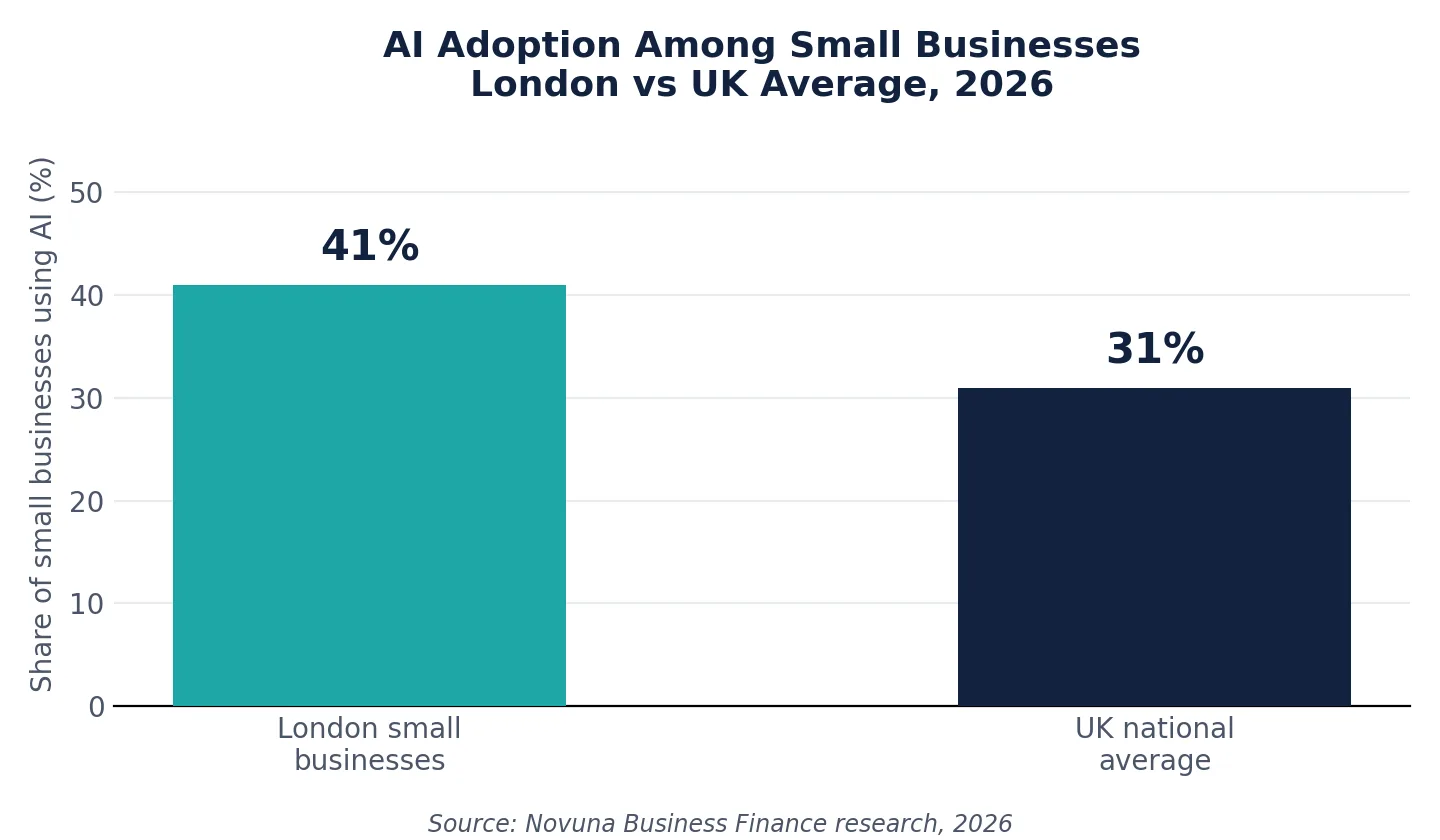
Fig. 1: London small businesses report higher AI use than the UK average. Source: Novuna Business Finance, 2026.
Website vs Web Application: Why the Difference Matters
The terms website and web application get used interchangeably, but the distinction affects how much AI can realistically help, and how much a project should cost. Most growing businesses in London eventually need both: a strong website to bring visitors in, and a well-built web application to turn them into customers.
Website vs web application, at a glance:
Feature | Website | Web application |
|---|
Main purpose | Presents information about your business | Lets users complete a task or transaction |
Typical examples | Homepage, service pages, contact form | Booking system, client portal, online checkout |
Level of interactivity | Low to moderate | High, often account-based |
Development complexity | Lower | Higher, with more custom logic |
Best suited to | Brand presence and lead generation | Day-to-day operations and revenue |
The pace of change behind all this is real. The British Chambers of Commerce, working with Atos, tracked active AI use among UK SMEs rising from 23 percent in 2023 to 54 percent by early 2026, which is close to becoming the baseline rather than a niche trend. The practical question for a business in London is no longer whether to think about AI; it is which parts of the process actually benefit from it.
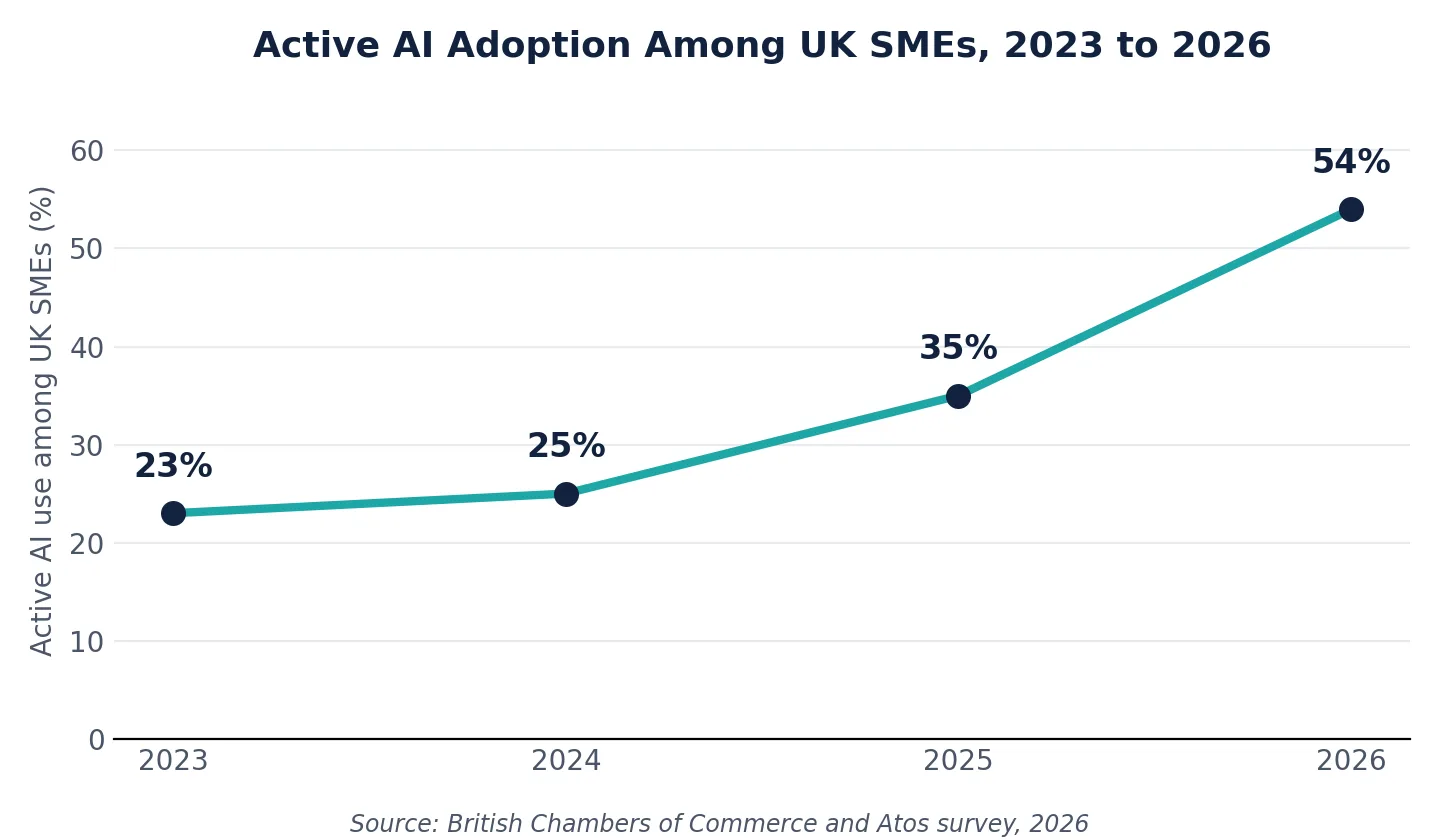
Fig. 2: Active AI adoption among UK SMEs has more than doubled since 2023. Source: British Chambers of Commerce and Atos, 2026.
What This Means If You Run a Business in London
Practical Tips Before You Start a Web Development Project
Audit your current site or web application first. Know what is actually underperforming- speed, mobile experience, or conversion- before adding AI features on top of problems that have nothing to do with AI.
Ask your agency how they use AI, not just whether they do. A good answer names specific stages, such as prototyping or code review, rather than a vague reference to the latest technology.
Prioritise the web application over the brochure site if that is where your business makes money. A booking system or online checkout usually deserves more budget than another static page about your company.
Keep a person in the loop for anything customer facing. Chatbots and generated copy should be reviewed by someone who knows your customers before they go live.
Build accessibility and security in from day one. Retrofitting either later is more expensive than doing it properly the first time.
Track Core Web Vitals and genuine page experience rather than vanity metrics. Google's own guidance on helpful content points the same way: usefulness and speed matter more than surface-level AI features.
Plan for ongoing maintenance. AI can speed up delivery, but a website or web application still needs updates and support long after launch.