This is exactly why so many businesses that come to us after months of Google Ads alone start asking how to find a top SEO company in UK to build something that keeps working once the ad budget stops.
Which Should You Choose First? 5 Questions to Ask Yourself
1. How soon do you need customers?
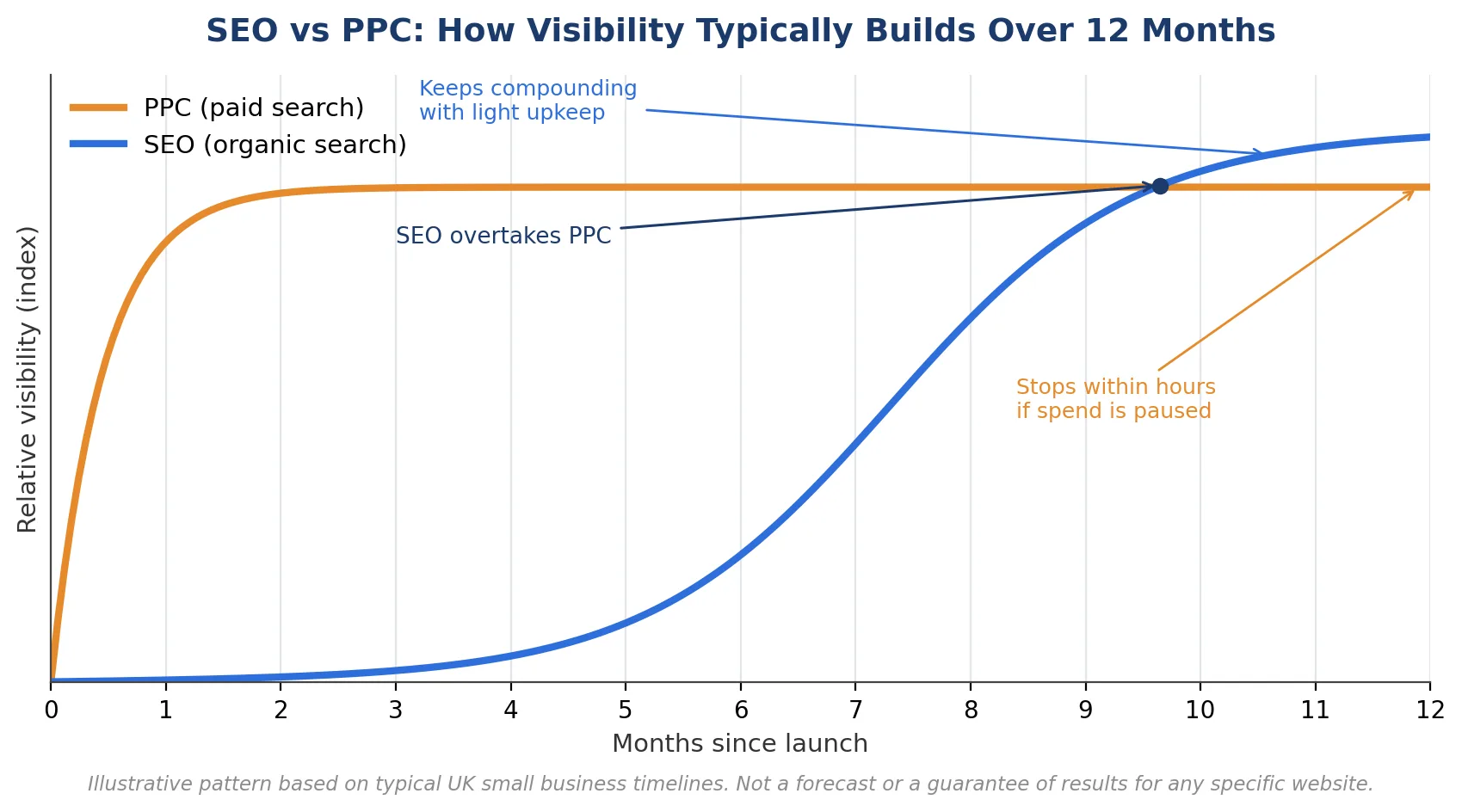
If cash flow is tight or you have just launched, PPC gets you in front of people this week. SEO is a poor fit if you cannot wait three to six months for traction.
2. What is your realistic monthly budget?
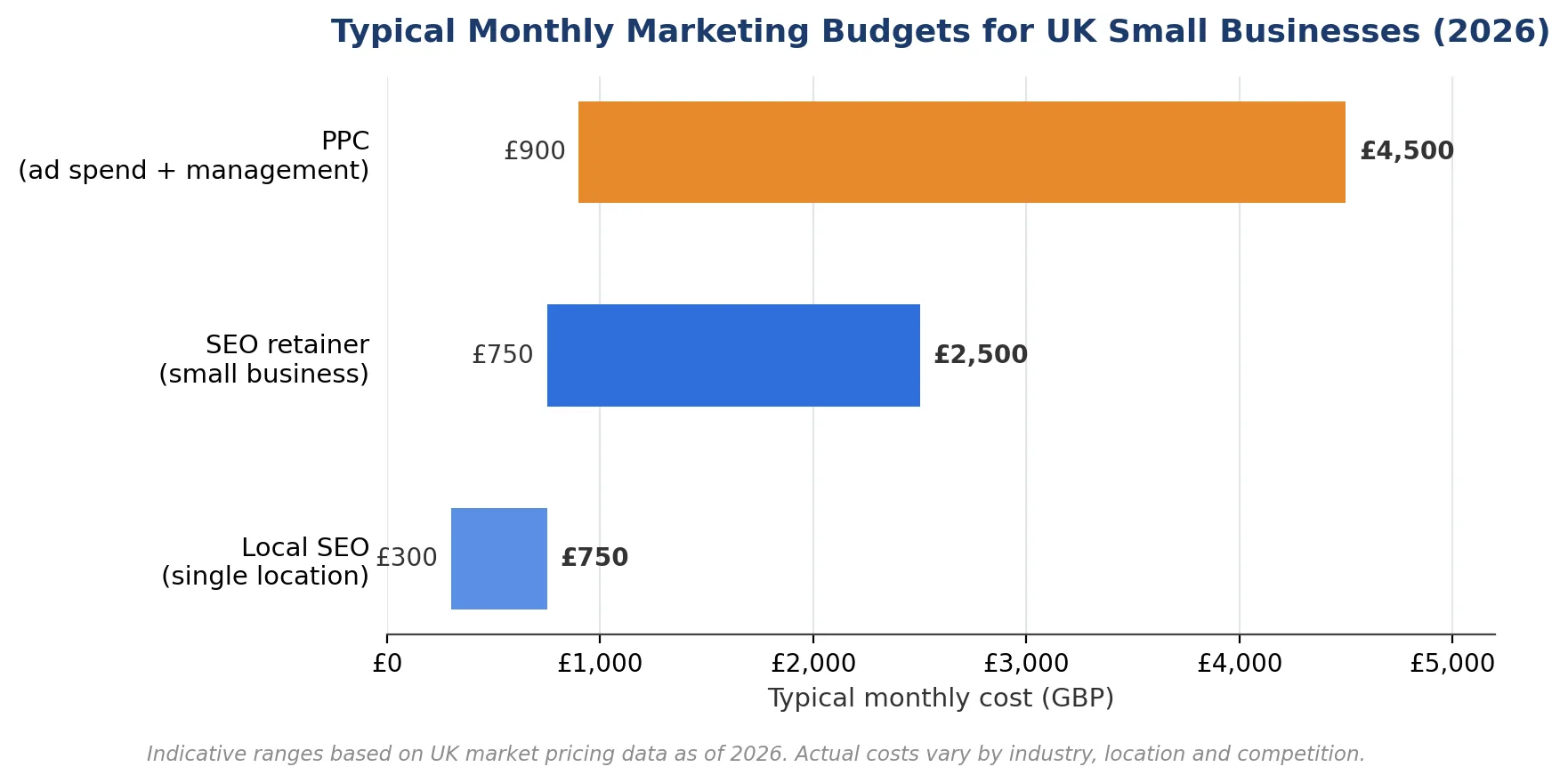
Committing £750 to £1,000 a month for six months makes SEO workable. On £300 to £500 a month, PPC usually stretches further short-term, since you can start small and scale as it proves itself. Below roughly £750 a month, SEO rarely moves the needle in the UK.
3. How competitive is your industry?
Costs and difficulty both rise with competition. In legal, finance and insurance, a single Google Ads click can cost £10 or more, and organic results are dominated by established sites. A niche local trade can often rank for valuable terms within months, and pay well under £2 per click on PPC alongside it.
4. Is your business local, national or ecommerce?
A local tradesperson or clinic usually gets the fastest return from local SEO built around a strong Google Business Profile, with PPC topping up urgent enquiries. A national service business often needs PPC to lead at first, since competitive national terms take longer to rank for. An ecommerce store benefits from running both together: paid search reveals which products and terms convert, feeding straight into content strategy and category page SEO.
5. Does your website already convert?
If your site is slow, unclear, or untested with real visitors, sending it PPC traffic is like pouring water into a bucket with a hole in it. Fixing the basics first, clear pricing, a simple enquiry form, fast-loading pages, saves considerable wasted spend once paid ads switch on.
Business type | Start with | Why |
|---|
Local trade or clinic (single location) | Local SEO, with PPC as a top-up | Lower competition for “near me” searches; PPC covers urgent gaps |
National service business | PPC first, SEO in parallel | Competitive national keywords take longer to rank |
Ecommerce store | PPC and SEO together from day one | PPC data reveals which products and terms convert, guiding content strategy |
Brand new website, no traffic history | PPC, plus foundational technical SEO | The site needs to prove it converts before you scale SEO investment |
Table 3: Where different UK small businesses should start
Why Not Both? A Top SEO Company in UK Runs SEO and PPC Together
Most established UK small businesses do not pick one channel forever, they sequence and combine them. A few ways this works in practice:
Start with PPC to generate cash flow and gather conversion data while SEO builds in the background.
Feed winning phrases from PPC's search term reports into your content strategy.
Once rankings mature, scale PPC back to keywords SEO has not yet won, or shift it towards remarketing.
Run a small budget on your own brand name too, so your organic listing reassures searchers while ads guard against competitor bids.
Take a typical example: a joinery business in Kent might start with PPC alone, spending around £600 a month for its first steady stream of enquiries. Within months, search term data could reveal that “custom fitted wardrobes Kent” converts particularly well, becoming the centrepiece of its content strategy. A year on, with that phrase ranking organically, the business can trim its PPC budget while enquiries keep climbing.
Getting SEO Right: Three Pillars That Actually Move Rankings
Technical SEO: The Foundation Google Has to Trust
Technical SEO covers what happens behind the scenes of your website: how fast it loads, whether Google can crawl and index every page, whether it works properly on mobile, and whether the underlying code sends clean signals. A beautifully written page will not rank if the site takes eight seconds to load or throws errors when Googlebot tries to crawl it.
Run your site through Google's PageSpeed Insights and fix anything flagged as poor.
Check Google Search Console regularly for crawl errors and broken links.
Test how your site actually loads on a mid-range mobile phone, not just a work laptop.
Content Strategy: Answering What People Actually Search For
A strong content strategy starts with real search intent, not guesswork. Instead of writing about what you want to say, you research the specific questions and phrases customers are already typing into Google, then build pages that answer them thoroughly.
Use Google Search Console and the “People also ask” boxes to find real questions your audience is asking.
Group related keywords into topic clusters, such as one core “boiler repair” page linked to supporting pages on common faults and emergency call-outs, rather than scattering thin, disconnected pages.
Refresh and expand your best-performing pages every few months rather than only publishing new ones, since Google rewards pages that stay accurate and useful.
Local SEO: Winning the “Near Me” Searches
For any UK small business with a physical location or a service area, local SEO is often the fastest route to a return from organic search, since competition for hyper-local searches tends to be far lower than for national keywords. A large share of people who search for a business “near me” on their phone go on to visit or contact that business within a day.
Claim and fully complete your Google Business Profile: opening hours, photos, service areas and an accurate category.
Ask happy customers for Google reviews consistently. A steady flow of recent reviews outperforms a handful from years ago.
Keep your business name, address and phone number identical everywhere they appear online, since inconsistency undermines Google's trust in your listing.
Getting PPC Right: 5 Quick Wins
A well-run PPC account can outperform a clumsy one on half the budget. A few habits make the biggest difference:
Send traffic to a dedicated landing page that matches the advert, not your generic homepage.
Add negative keywords weekly so you stop paying for irrelevant clicks, such as a plumbing advert showing for “plumbing course” searches.
Install proper conversion tracking before you spend a penny, so you know which keywords actually produce enquiries, not just clicks.
Start with a tightly focused keyword list and a modest daily budget, then expand once you see what converts.
Review search term reports weekly for the first month. This is where most wasted spend hides.
How to Choose the Top SEO Company in UK (or PPC Partner)
Whether you start with SEO, PPC or both, most owners eventually want an expert pair of hands, since doing this well alongside running a business is a full-time job in itself. A few checks are worth making before you sign anything.
Ask to see transparent, plain-language reporting covering rankings, traffic and enquiries, not just a dashboard of jargon.
Ask how long they have traded and whether they hold recognised accreditations, since information security certifications matter more than ever.
Ask for an honest view on timelines. Any agency promising guaranteed number one rankings within weeks is not being straight with you.
Look for a team offering SEO and PPC together, since a joined-up strategy usually beats two disconnected suppliers.
At GSS Tech Solutions, we work as a top SEO company in UK rather than a set-and-forget supplier, with a dedicated point of contact, transparent reporting, and services spanning technical SEO, content strategy, local SEO and Google Ads under one roof. If you would like a second opinion on where to spend first, that is a conversation we are always happy to have.
Frequently Asked Questions
Is SEO or PPC better for a small business?
Neither is universally better. PPC wins when you need enquiries quickly or want to test a new offer, while SEO wins on cost per lead over the long run. Most UK small businesses do best starting with whichever channel matches their budget and timeline, then adding the other once the first is working.
How long does SEO take to show results in the UK?
Most UK small businesses see meaningful ranking movement within three to six months, with stronger results building over six to twelve months. Competitive industries and brand new websites tend to sit towards the longer end.
How much should I budget for SEO or PPC as a small business?
A realistic 2026 starting point is roughly £750 to £2,000 a month for SEO, or £500 to £2,000 in ad spend plus a management fee for PPC. Local SEO for one location can start from around £300 to £500 a month.
Can I do SEO myself instead of hiring a top SEO company in UK?
You can, particularly for local SEO basics like your Google Business Profile, and this suits businesses with more time than budget. Technical SEO and competitive PPC are harder to manage without experience, and mistakes in Google Ads can burn through a budget fast, so many owners bring in a top SEO company in UK once the stakes rise.
What happens if I stop paying for SEO or PPC?
PPC traffic stops within hours of pausing a campaign. SEO rankings tend to hold for a while afterwards, though they gradually slip as competitors keep publishing and building links, so ongoing maintenance protects the investment already made.
Should an ecommerce business prioritise SEO or PPC first?
Most ecommerce stores benefit from starting with PPC, particularly Google Shopping, since it generates sales data almost immediately and shows which products and terms convert. That data then guides which pages to prioritise for SEO, so both channels work from the same evidence.
Final Words
There is no single right answer to SEO vs PPC, only the right answer for where your business stands today. If you need customers this month, hire a top SEO company in UK, start with PPC and let it fund the insight that makes your SEO smarter later. If you have a modest but steady budget and can commit to the long game, start building SEO now, because every month you wait is a month a competitor spends building rankings you will eventually have to overtake.
For most UK small businesses, the honest answer is not really “SEO vs PPC” at all. It is SEO and PPC, sequenced properly. Get the basics right, technical SEO, a content strategy built on real search intent, sharp local SEO, and a tightly managed PPC account, and you stop choosing between channels and start building a search presence that works from every angle.
If you would like a second opinion on where your budget should go first, GSS Tech Solutions being a top SEO company in UK offers a free strategy call to look at your website, your competitors and a realistic plan for both channels. Call 0203 599 8122 or email contact@gsstechsolutions.co.uk to get started.