
Picture a typical Monday inside one of the SEO agencies back in 2020. The content team is buried in a spreadsheet, clustering keywords by hand. The technical lead is switching between five different tools, trying to stitch together one coherent audit. A junior account manager is writing a location page for a client’s third branch, quietly swapping one town name for another and hoping nobody notices the join.
Now picture that same Monday in 2026. The keyword clustering happened overnight. The technical audit landed in a single dashboard, already ranked by impact. And that location page got flagged by the team’s own tools as exactly the kind of thin, copy-paste content that Google’s local ranking systems have learned to bury quietly.
Same agency, same goal of getting a client found online, a completely different working day.
AI content tools haven’t just changed what turns up in a Google search. They’ve rewired what SEO agencies actually spend their time on, which skills they hire for, and where human judgement still has to sit. This article looks at that shift in practice across content strategy, technical SEO, and local SEO, and at what it means if you’re trying to work out whether an agency’s use of AI is genuinely helping you or just cutting corners.
The Old SEO Agency Playbook Vs the 2026 Reality
For years, hiring an SEO agency meant a fairly predictable set of deliverables: a keyword list, a content calendar, a handful of backlinks, and a monthly report. AI content tools haven’t torn up that list so much as compressed how long each item takes and shifted where agencies spend their remaining time.
The table below is a simplified snapshot of that shift. Exact figures vary by agency and niche, but the direction of travel is consistent.
Agency Task | Typical Approach in 2020 | Typical Approach in 2026 |
|---|---|---|
Keyword research | Manual, spreadsheet-based, one tool at a time | AI groups keywords by topic and intent in minutes; a strategist sets direction |
Content briefs | Roughly two hours of manual research per brief | AI-assisted research in about ten to fifteen minutes, then human refinement |
Technical audits | Several tools stitched together by hand | One AI-assisted audit combining crawl data, Core Web Vitals and logs |
Content drafting | Fully human first draft from a blank page | AI-assisted first draft, edited and fact-checked by a specialist |
Local landing pages | One template, town name swapped by hand | AI batch-drafts local detail; a human reviews before publishing |
Reporting | Manually built monthly slide deck | Automated dashboard plus human commentary |
This shift matters because it changes what clients are paying for. Increasingly, they aren’t paying an SEO agency to type. They’re paying for judgement: knowing which keywords are worth chasing, which AI-drafted paragraph is actually accurate, and which shortcuts will eventually get a site into trouble with Google.
What SEO Agencies Actually Do with AI Content Tools Now
Zoom into the day-to-day and three areas show the clearest change: content strategy, technical SEO, and local SEO.
Content Strategy: From Writing Pages to Architecting Topics
The content side of an SEO agency has probably changed the most. A few years ago, a content strategist’s day revolved around individual articles: pick a keyword, write a page, move on. AI content tools have pushed the job further up the chain, from producing pages to architecting topics.
Modern content platforms can pull together a working brief, complete with subtopics, common reader questions, and gaps in a competitor’s coverage, in roughly the time it takes to make a cup of tea. Some agencies report that research-heavy briefs which once took a strategist around two hours can now be assembled in ten to fifteen minutes with AI assistance, though the real figure varies by topic.
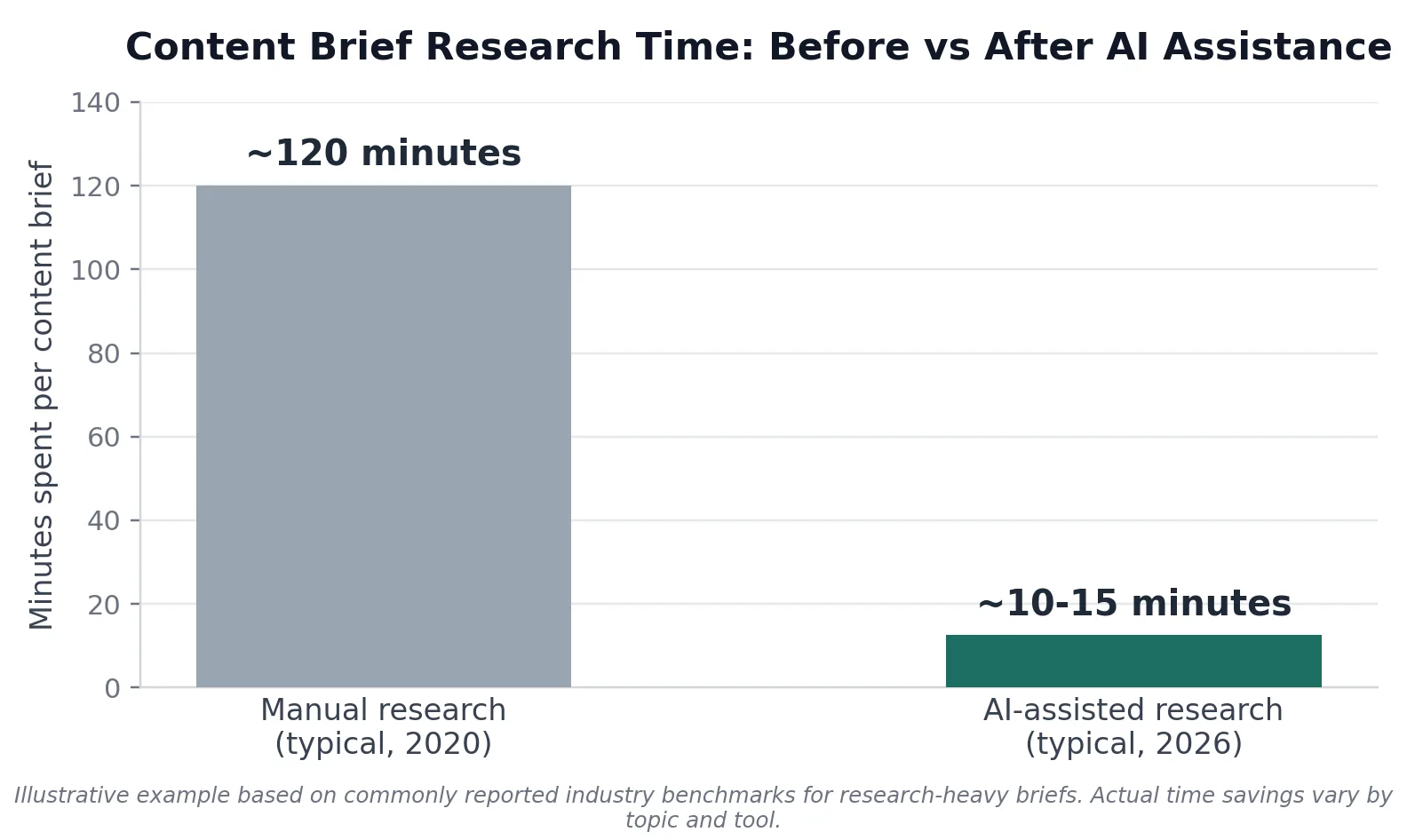
Figure 1: An illustrative example of how AI research assistance has compressed content brief turnaround time.
The strategist’s job now starts after the brief exists: deciding which subtopics deserve a full page of their own, spotting the gap in a topic cluster nobody has filled yet, and working out what original angle a client can genuinely offer.
Quality control has also turned into a full-time responsibility rather than an afterthought. An AI draft is a starting point, not a finished article. A good SEO agency will have someone checking every AI-assisted draft for factual accuracy, confirming that statistics are real and current, and making sure the piece sounds like the client rather than every other AI-written page on the same topic.
Practical tip: before publishing anything AI-assisted, run it past three questions. Does this page say something a competitor’s page doesn’t? Would someone who genuinely knows the subject nod along while reading it? Would you be comfortable putting a named author’s face and job title next to it? A “no” to any of those means another editing pass.
Technical SEO: Audits That Used to Take Days Now Take Hours
Technical SEO has always been the unglamorous engine room of an SEO agency, and AI has changed its shape in two ways.
First, audits move faster. Instead of manually exporting data from a crawler, Google Search Console, a backlink tool, and server logs, then stitching it together in a spreadsheet, many agencies now run AI-assisted audits that cross-reference all of this automatically and return a prioritised list of fixes. Diagnostic work that once took a specialist the best part of a day can surface in a couple of hours, leaving more time to fix the highest-impact problems instead of hunting for them.
Second, the job itself has genuinely expanded. Technical SEO in 2026 isn’t only about keeping Googlebot happy. Agencies now need to check how a site treats a whole family of AI crawlers, including the bots behind AI Overviews and various chatbot answer engines, alongside the traditional search bots. A robots.txt file last reviewed in 2021 might be quietly blocking the very crawlers that could get a client cited in an AI-generated answer. Structured data has taken on similar new weight, since clean schema markup helps both Google and AI systems understand what a page is about and who is responsible for it.
Practical tip: check when your robots.txt file was last reviewed. If it only mentions Googlebot and Bingbot, it hasn’t kept pace with how AI systems now access the web, and it’s worth an audit.
Local SEO: Same Fundamentals, Faster Delivery
Local SEO looks, on the surface, like it hasn’t changed much. A complete Google Business Profile, consistent business details across directories, and a steady stream of genuine reviews are still the foundation. What’s changed is how much content sits around that foundation, and how quickly it can be produced properly.
Take a tradesperson with branches in three towns. A few years ago, a genuinely useful, locally specific page for each branch meant a writer researching every area individually, which in practice often meant it simply didn’t happen, so agencies fell back on one template with the town name swapped out. AI tools have made it realistic to draft that content properly in batches, pulling in relevant local landmarks, seasonal services, and area-specific detail for each branch in a single pass. A human then reviews and adjusts every page before it goes anywhere near “publish”.
This matters more than it might first seem, because Google’s local ranking systems have got noticeably better at spotting pages that are just a template with the city name changed, and treating them as low value. The agencies getting genuine results from local SEO in 2026 are the ones using AI to produce more locally specific content, not simply more generic content, faster.
Practical tip: look honestly at your own location pages. If you could swap the town name on two of them and nobody would notice, that’s exactly the kind of content Google’s local systems are learning to discount.
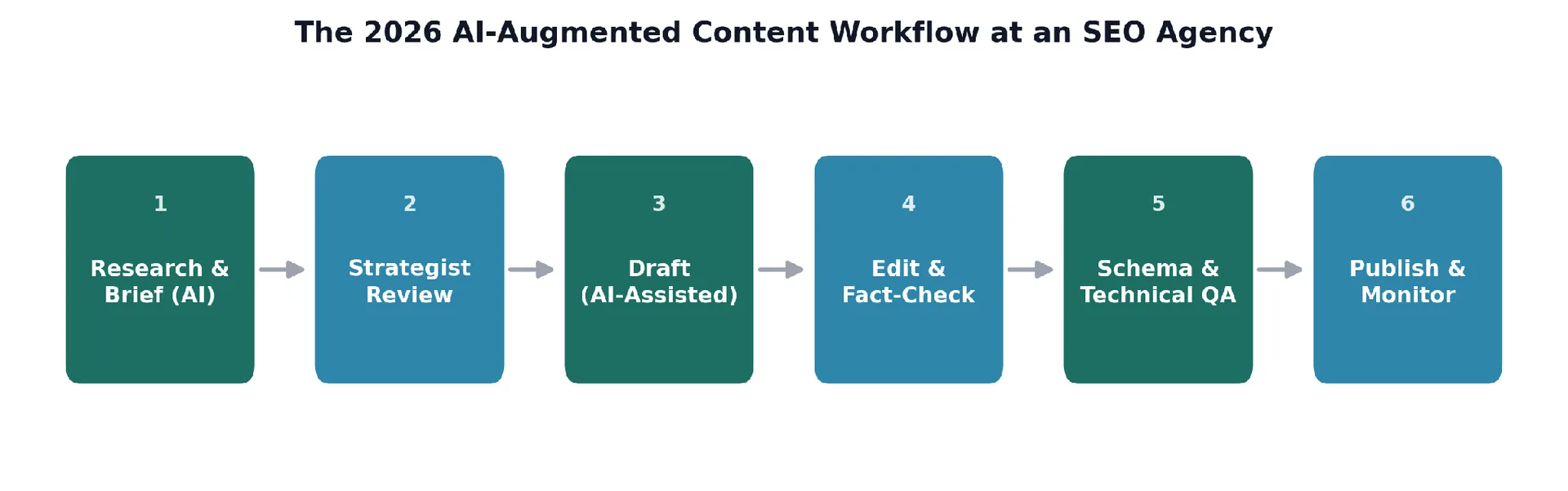
Figure 2: How content moves from research to publication in an AI-augmented SEO agency workflow.
The New Skills Inside a 2026 SEO Agency
The changes above explain why job titles inside SEO agencies have started to look different. Purely repetitive execution roles, built around manually clustering keywords or writing first drafts from a blank page, are shrinking. In their place, agencies are hiring for judgement-heavy roles: strategists who direct AI tools rather than compete with them, editors who specialise in checking AI-assisted content for accuracy and brand voice, and technical specialists comfortable with both classic ranking factors and the newer world of AI answer engines.
New titles have started appearing on agency org charts that would have looked unfamiliar three years ago: content SEO managers, AI content evaluators, and specialists who test how AI systems answer questions in a client’s industry, then adjust content and structured data to improve the odds of being cited.
None of this means agencies need fewer people, or that clients need less oversight from a human account team. If anything, that human judgement matters more than ever, because AI tools make it very easy to publish a lot of average, inaccurate, or generic content very quickly, long before a client notices the damage to their reputation or rankings.
Where AI Content Tools Still Fall Short
None of this is an argument for handing content over to AI unsupervised. AI content tools are genuinely good at pattern recognition, drafting speed, and pulling structured information together quickly. They are not good at several things that matter enormously for search performance.
They cannot verify a fact against reality. An AI-assisted draft can state a confident, smoothly written, entirely wrong statistic, and it will read just as convincingly as a correct one. They cannot demonstrate genuine first-hand experience either, one of the four pillars Google looks for under its E-E-A-T framework of experience, expertise, authoritativeness and trustworthiness, because an AI tool has never actually used the product, visited the premises, or lived through the problem it describes. Left unsupervised, these tools also default to safe, average, slightly generic output, precisely the kind of content that struggles to stand out in search results or get cited in an AI-generated answer.
Google has been fairly direct on this point. Its own guidance on creating helpful, reliable, people-first content makes clear that content isn’t judged on whether AI was involved in making it, but on whether it’s genuinely useful, original, and created primarily to help the reader rather than to game the rankings. Scaled, unsupervised AI content produced purely to attract search traffic is treated as a policy breach, not a shortcut worth taking.
How to Tell If an SEO Agency Is Using AI Responsibly
If you’re trying to work out whether a prospective SEO agency’s approach to AI is helping you or just cutting corners, a short conversation usually tells you most of what you need to know.
Question to Ask | What a Good Answer Sounds Like |
|---|---|
Where does AI fit into your process? | Names specific stages (research, drafting, audits) and says which stay human-led |
Who checks AI-assisted content before it’s published? | A named role or person, not “the system checks it” |
How do you handle facts and statistics in AI drafts? | Describes a verification step against sources |
How do you measure success beyond rankings? | Mentions AI citation or answer-engine visibility tracking |
Can I see a real brief-to-published-page example? | Happy to walk you through an actual workflow |
An agency that can answer these clearly, with specifics rather than reassurance, is generally one where AI is speeding up good work rather than replacing the thinking behind it.
Frequently Asked Questions
Will AI content tools replace SEO agencies?
Unlikely, at least not completely. AI tools have taken over a lot of the repetitive groundwork, but deciding strategy, verifying accuracy, and protecting a client’s brand voice and trustworthiness still need human judgement. Most SEO agencies are using AI to do more work with the same team, rather than to remove the team.
Do I need to disclose that content on my website was created with AI help?
There’s no blanket UK legal requirement to label every piece of AI-assisted content. However, Google’s own guidance suggests being transparent about automation where a reader would reasonably want to know how something was made, particularly for reviews, news, or advice on anything serious like health, money, or safety.
Does Google penalise content because it was written with AI?
No, not simply for that reason. Google has said repeatedly that its systems judge content on whether it’s helpful, original, and people-first, regardless of whether a human, an AI tool, or both were involved in producing it. What does get penalised is content mass-produced at scale primarily to manipulate rankings, whatever tool was used to create it.
What AI tools do SEO agencies commonly use in 2026?
Most agencies now use a mix of platforms: AI-assisted content optimisation and brief-building tools for content strategy, AI-agent features built into established platforms for technical audits, and separate tools for tracking visibility inside AI answer engines such as AI Overviews and various chatbots.
How has local SEO changed with AI content tools?
The fundamentals- a complete Google Business Profile, consistent business details, and genuine reviews- haven’t changed. What’s changed is that agencies can now produce properly localised content, posts, and review responses at a scale that used to be impractical, provided a human still checks each piece for genuine local detail first.
How can I tell if an SEO agency is using AI responsibly?
Ask them directly where AI fits into their process, who checks AI-assisted work before it’s published, and how they verify facts and statistics. Clear, specific answers are a good sign. A vague reassurance that “our AI handles it” is usually a cue to ask more questions.
Final Words
AI content tools have changed the mechanics of running SEO agencies far more than they have changed the underlying goal. Keyword research is faster, technical audits are broader and quicker, and local content can be produced at a scale that simply wasn’t practical by hand a few years ago. But the actual job, helping a business get found by the right people and trusted once they arrive, is exactly what it always was.
The SEO agencies worth working with in 2026 are the ones using AI content tools to free up time for the parts of the job that still need a person: judgement, fact-checking, original thinking, and a genuine understanding of the client’s business. That’s the standard we hold ourselves to on the SEO side of GSS Tech Solutions, alongside the web development, AI, and data services we deliver for clients across the UK.
If you’d like a straightforward look at how your current approach compares with what a modern SEO agency should be doing, get in touch with our team or take a look at our professional SEO services to see how we combine AI-assisted efficiency with hands-on strategy and reporting.