Every SEO pitch sounds the same. Page one rankings. Explosive traffic growth. Guaranteed results in ninety days. If you have sat through more than one of these conversations, you already know the words rarely match what turns up in the monthly report three months later.
That gap between the pitch and the proof is exactly why so many UK businesses feel let down by SEO, not because the discipline does not work, but because nobody told them what a genuine result actually looks like. Rankings on their own do not pay the bills. Traffic on its own does not either.
This article sets out, plainly and with real numbers, what results from a top SEO company in UK genuinely look like in 2026, which metrics matter, which ones are decoration, what a report should contain month by month, and how to tell a serious agency from one that is simply good at screenshots.
Why Results in SEO Has Become Harder to Define in 2026
Search Barely Looks Like Search Anymore
More than six in ten searches in the UK now end without a single click to any website, a figure that has climbed steadily as Google's AI Overviews, featured snippets, and answer boxes settle more queries directly on the results page. When an AI Overview appears, the organic click-through rate for the pages ranking underneath it drops sharply, often by close to a fifth. None of this means SEO has stopped working. It means the old scoreboard- count the keywords, count the visits- no longer tells the whole story.
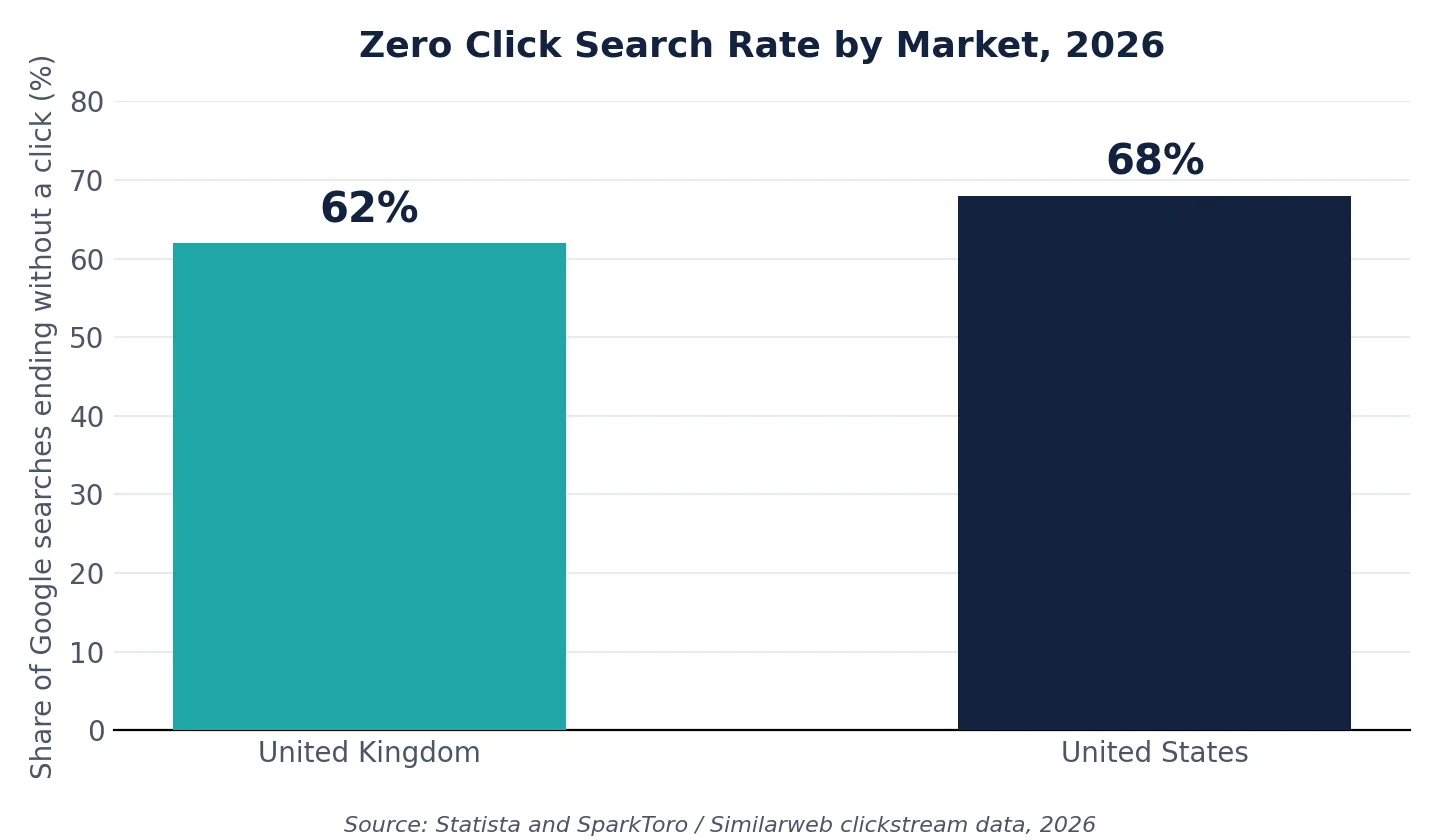
Fig. 1: UK searches increasingly resolve on the results page itself. Source: Statista and SparkToro, 2026.
Why Rankings Alone No Longer Prove Anything
A ranking report full of green arrows still gets sent out every month by agencies across the UK, and it still means very little on its own. Position three for a keyword nobody searches for is not a result. Position one for your own brand name, which you would likely hold regardless of any SEO work, is not a result either. A genuine result changes something a business owner actually cares about: enquiries, bookings, sign-ups, or sales.
The Metrics That Actually Matter From a Top SEO Company in UK
Once rankings stop being the finish line, the question becomes what to measure instead. The metrics below are the ones that hold up under scrutiny.
Organic Visibility Share, Not Just Position
Rather than tracking one keyword's position, visibility share looks at how often your site appears across your entire target keyword set, including snippets, local packs, and AI citations. A business climbing from 20 percent to 45 percent visibility share across its core terms is growing its footprint in a way a single ranking cannot show.
Qualified Traffic and Conversion Rate
More traffic is only useful if it converts. Organic search converts at roughly 2.4 to 3 percent on average across sectors, and a top SEO company in UK should be reporting that figure alongside raw sessions, not instead of it. A smaller amount of highly relevant traffic converting at 4 percent is worth more than triple the traffic converting at under 1 percent.
Local Pack and Local SEO Performance
For any business with a physical location or a service area, appearances in the Google local pack, along with calls, direction requests, and profile views, are a more direct signal than national rankings. Local SEO tends to be where results show up fastest, because the competition for a defined geographic area is narrower than for a national term.
Technical Health Score
Crawl errors, page speed, broken links, and indexing coverage are unglamorous, but a site that Google cannot crawl efficiently will not be cited anywhere, on the search results page or in an AI Overview. Tracking a technical health score month over month shows whether the foundation is actually improving.
Revenue and Cost Per Acquisition
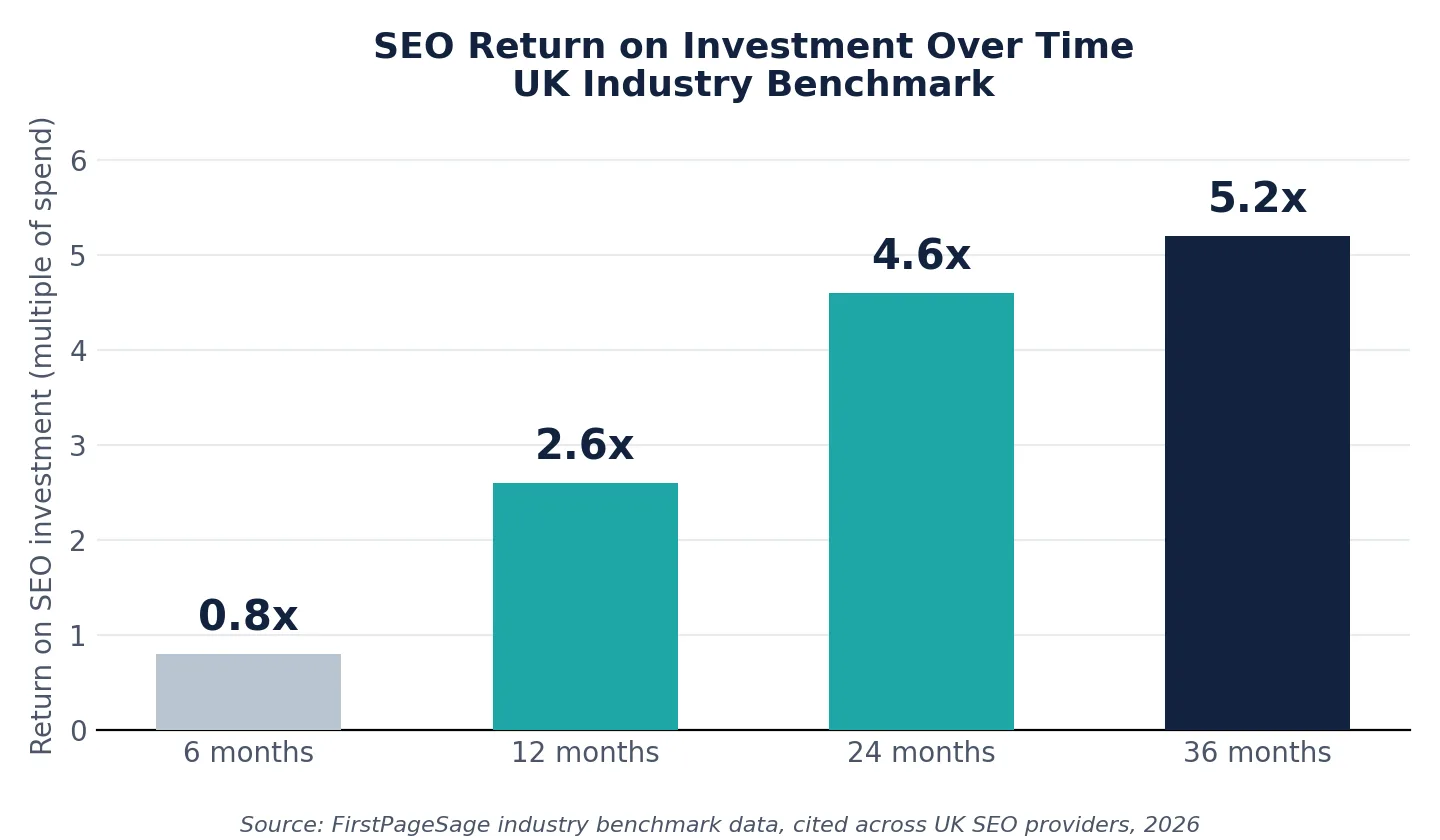
The metric that ultimately matters to a business owner is how much revenue organic search is generating, and at what cost, compared with other channels. UK SEO programmes typically move from close to break-even in the first six months to a return of roughly two and a half times spend by month twelve, and considerably more from month twenty-four onwards, according to industry benchmark data spanning multiple sectors.
Vanity metrics vs real results, side by side:
What gets reported | Why it sounds impressive | What it actually tells you |
|---|---|---|
Number of keywords ranking | Sounds like broad visibility | Meaningless without traffic or buyer intent behind those keywords |
Position one for your own brand name | Feels like a win | You would likely rank there regardless of any SEO work |
Total organic sessions | A big number, easy to screenshot | Says nothing about whether visitors became leads or sales |
Domain Authority score | Feels like a credibility rating | A third-party estimate Google does not use, easy to inflate |
Backlinks acquired | Looks like authority building | Quality and relevance matter far more than raw count |
Organic conversions and revenue | Less flashy on a slide | Directly tied to whether SEO is growing the business |
AI Overview and snippet citations | New and unfamiliar | Increasingly where visibility happens on searches with no click |