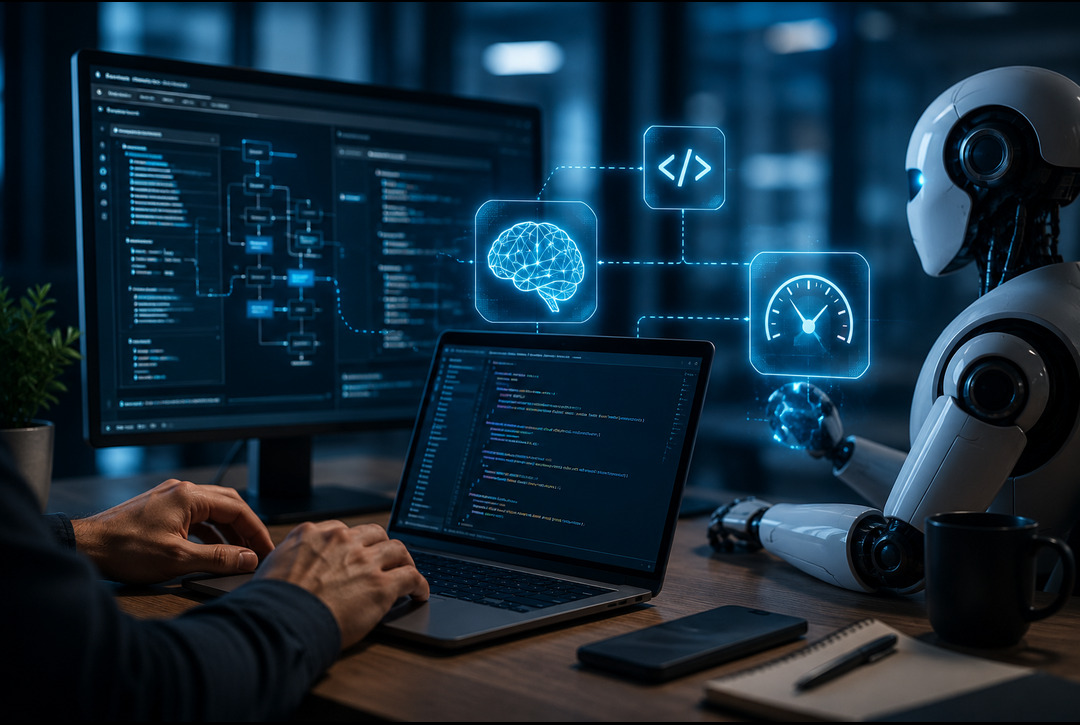
Leading software development agencies are using AI integration to reduce development timelines dramatically. By embedding AI tools into code generation, testing, project management, and AI chatbots development, agencies can deliver custom software development projects faster without compromising quality.
Ask any software development agency what their clients want most, and the answer is almost always the same: faster delivery, lower costs, and no surprises. For decades, those three demands have been in tension with each other. Speed costs money. Lower costs invite shortcuts. And surprises are practically built into complex software projects.
AI integration is changing that equation, and not in a small way.
Agencies that have embedded AI into their workflows are reporting dramatic reductions in development time. Some are cutting timelines by 30%. Others by half. A few are moving even faster. The gains aren’t coming from a single tool or a clever hack. They’re the result of rethinking how software gets built, from the first client conversation through to deployment.
This post breaks down exactly how a modern software development agency is using AI to work faster, where the biggest gains are coming from, and what this shift means for businesses commissioning custom software development in 2026 and beyond.
Why AI Integration Is Reshaping Custom Software Development
Custom software development has always been resource-intensive. Every project is different. Requirements shift. Bugs appear late. Integration points between systems create unexpected friction. Historically, the only reliable way to move faster was to throw more developers at a problem. However, it was an expensive and often counterproductive approach.
AI integration introduces a different kind of leverage. Rather than adding headcount, agencies are augmenting each developer’s output. A developer using AI-assisted coding tools can write, review, and test code significantly faster than one working without them. In simple words, AI’s impact on a software development agency extends well beyond code generation.
Where Does AI Actually Save Time? A Breakdown by Development Phase
AI delivers the greatest productivity gains when it’s applied across the entire software development lifecycle, not just during coding. While code generation often gets the most attention, AI also streamlines planning, documentation, testing, debugging, and even post-deployment support. The result is less time spent on repetitive tasks and more time focused on solving complex business and technical challenges. Research suggests that AI-assisted development can reduce time spent on coding-related activities by roughly one-third, with particularly strong gains in documentation, repetitive coding, testing, and debugging workflows. The development-phase wise breakdown is discussed below.
Requirements Gathering and Documentation
Before a single line of code is written, developers need to understand what they’re building. This phase of gathering requirements, aligning stakeholders, and producing technical documentation can consume weeks on complex projects.
AI tools now assist with structuring requirements, identifying ambiguities, and generating initial documentation drafts from meeting transcripts or client briefs. Natural language processing models can parse a client’s rough brief and surface gaps or contradictions that might otherwise only emerge during development. Catching these issues early is one of the highest-value interventions an agency can make.
Code Generation and Scaffolding
This is where the most visible time savings occur. Large language models like GitHub Copilot and Cursor help developers generate boilerplate code, suggest function completions, and scaffold entire modules based on plain-language descriptions.
For a software development agency working across multiple languages and frameworks, this is significant. A developer building a RESTful API in Node.js one week and a Python data pipeline the next can rely on AI assistance to bridge context gaps and maintain speed across both.
Importantly, these tools don’t replace developer judgement. They handle the repetitive and predictable parts of coding, freeing developers to focus on the logic and architecture decisions that actually require expertise.
Testing and Quality Assurance
Testing is consistently one of the most time-consuming phases of custom software development. Writing unit tests, running regression checks, and identifying edge cases; it adds up quickly and is often squeezed when project timelines tighten.
AI-powered testing tools can auto-generate test cases, identify high-risk code paths, and run continuous testing in parallel with development. Some tools analyse existing codebases to infer what tests should exist and flag where coverage is lacking.
The result: faster test cycles and fewer defects reaching production, two outcomes that clients care deeply about.
AI Chatbots Development and Integration
One of the most in-demand services at a software development agency right now is AI chatbot development. Businesses across industries want intelligent, context-aware chatbots embedded in their products for customer service, internal tooling, onboarding flows, and more.
Previously, building a functional AI chatbot from scratch required substantial machine learning expertise. Today, agencies can build sophisticated AI chatbots by combining pre-trained models (such as those from OpenAI or Anthropic) with custom data and logic layers. What might have taken three months can often be delivered in three to four weeks.
This is a concrete example of how AI integration compresses timelines on end deliverables, not just internal workflows.
Code Review and Debugging
Debugging is notoriously hard to predict. A bug that takes one developer four hours to find might take another four days. AI tools are becoming genuinely useful here, such as for analysing stack traces, suggesting likely causes, and sometimes identifying the fix before a developer has even fully read the error log.
Different platforms use AI to review code for bugs, security vulnerabilities, and style inconsistencies automatically. For a software development agency managing multiple simultaneous projects, automated code review reduces the bottleneck on senior developer time and maintains quality without slowing delivery.
What Does “Cutting Development Time in Half” Actually Look Like in Practice
It’s worth being specific, because “cutting time in half” can sound like marketing language.
Consider a mid-complexity web application: a custom CRM with user authentication, role-based access, a dashboard, API integrations, and an embedded AI chatbot. A year ago, a capable software development agency might estimate 14–18 weeks for this project.
With AI integration across the development lifecycle, AI-assisted requirements documentation, code generation for standard modules, automated testing, and a pre-built AI chatbot layer, the same agency can now target 8–10 weeks. That’s not a theoretical estimate. It reflects the kind of timeline compression agencies are actually reporting.
The savings come from multiple directions at once. Less time writing boilerplate. Fewer bugs reaching late-stage testing. Faster onboarding of new developers onto a project (because AI tools help them understand existing code more quickly). Shorter feedback loops between development and QA.
What This Means for Businesses Commissioning Custom Software
If you’re a business investing in custom software development, the rise of AI integration in development agencies has direct implications for how you should evaluate and engage a development partner.
Speed to Market
It is now a differentiator between agencies not just between products. An agency that has invested in AI tooling and workflows can credibly offer faster delivery without the quality trade-offs that speed usually brings. Ask prospective agencies directly how they use AI in their process, and what specific time savings they can demonstrate.
Pricing Models May Shift
Some agencies still price custom software development purely by time and materials. As AI increases developer output, the relationship between hours worked and value delivered becomes less direct. Fixed-scope pricing may become more common and potentially more favourable for clients.
Inclusion of More Features
The scope of what’s feasible within a budget is expanding. Features that were previously too costly to include in a project like a sophisticated AI chatbot or advanced analytics dashboard are becoming more accessible as AI integration reduces the effort required to build them.
What Responsible AI Integration in a Software Development Agency Looks Like
Speed is valuable. However, the agencies gaining a genuine competitive edge aren’t just moving faster, they’re maintaining or improving quality as they do.
Responsible AI integration means treating AI-generated code with the same scrutiny applied to human-written code. It means training developers to use AI tools effectively, not just quickly. It means being transparent with clients about where AI is being used and how it affects the project.
It also means recognising where AI adds limited value. Architecture decisions, stakeholder communication, security-sensitive components, and novel problem-solving still benefit most from experienced human judgement. The best software development agencies use AI to amplify their developers, not to sidestep the expertise that clients are actually paying for.
Is AI Integration Right for Every Software Development Project
AI integration delivers the greatest time savings on projects with significant standard components: web applications, mobile apps, API development, data pipelines, and AI chatbot builds. The more a project involves well-understood patterns and established technologies, the more AI tools can assist.
For highly novel or specialised work, custom hardware interfaces, proprietary algorithm development, or highly regulated environments with strict compliance requirements, AI tools are still useful, but the time savings tend to be more modest.
The honest answer is that most custom software development projects contain a mix of both. An experienced software development agency will know how to apply AI integration selectively, concentrating its use where it adds the most value.
The Future of AI in Software Development: What Comes Next
AI integration in software development is still early. The tools available today are impressive, but they’re not close to their ceiling.
In the near term, expect AI to become more capable at managing end-to-end development tasks, not just assisting with individual steps. Agentic AI systems, which can plan and execute multi-step tasks autonomously, are already being tested in development environments. When these mature, a software development agency will be able to automate entire workflows that currently require human orchestration.
Longer term, the agencies that thrive will be those that treat AI integration as an ongoing capability to build, not a tool to occasionally use. The ones that invest in training, tooling, and workflow design now will be significantly better positioned as the technology evolves.
How Does a Software Development Agency Use AI to Reduce Development Time?
A software development agency uses AI integration across multiple stages of the development lifecycle, including requirements documentation, code generation, automated testing, debugging, and AI chatbot development. By automating repetitive tasks and augmenting developer output, agencies can deliver projects significantly faster without reducing quality.
Can AI integration be Used in All Types of Custom Software Development Projects?
AI integration is most effective on projects with standard components, such as web applications, mobile apps, APIs, and AI chatbot builds. Highly specialised or novel projects still benefit from AI assistance, but the time savings tend to be smaller. Most custom software development projects contain both standard and complex elements, so experienced agencies apply AI selectively.
What is AI Chatbot Development, and Why is it Faster Now?
AI chatbots development involves building intelligent, conversational interfaces for products or internal tools. It’s significantly faster now because agencies can build on pre-trained large language models, such as those from OpenAI or Anthropic, rather than training models from scratch. A chatbot that previously took three months to build can often be delivered in three to four weeks.
How should I evaluate whether a software development agency is genuinely using AI?
Ask the agency to explain specifically where AI integration features in their development process, which tools they use, and what time savings they’ve measured on previous projects. A credible agency will be able to give concrete examples rather than vague claims about “leveraging AI.”
Does AI Integration Affect the Quality of Custom Software Development?
When implemented responsibly, AI integration maintains or improves software quality. AI-powered testing tools increase test coverage and catch bugs earlier. Automated code review identifies security vulnerabilities and style issues before they reach production. The key is that AI-generated output should be reviewed and validated by experienced developers, not treated as automatically correct.
Final Words
The gap between agencies that have genuinely embedded AI into their development workflows and those that haven’t is already meaningful. It will widen considerably over the next two to three years.
For businesses commissioning custom software development, this is actually good news. Faster delivery, better quality, and more ambitious scope within the same budget are all becoming more achievable, as long as you’re working with a software development agency that has done the hard work of integrating AI thoughtfully into how they build.
The question isn’t whether AI will reshape software development. It already is. The question is whether your development partner is ahead of that shift or catching up to it.
Are you ready to build a product that can grow with your business? Reach out to our software development agency today and start turning your vision into a scalable reality.