You have a clear idea for a customer portal, a booking platform or an AI chatbot. You choose a software development agency, agree a price and watch the project take shape. Then, six months after launch, someone asks a simple question: who actually owns the code?
Most business owners assume the answer is obvious. You paid for it, so it is yours. UK law is less straightforward. Unless your contract says otherwise, the people who write the code are usually its first owners, and you may hold nothing more than a licence to use it.
That gap catches out start-ups and established firms alike, and it gets trickier once AI integration enters the picture. In this article, we explain what UK law says about code ownership, where the common traps sit and exactly what to ask for before you sign.
This article is general information, not legal advice. For a specific contract, speak to a solicitor.
The Short Answer: Who Owns the Code?
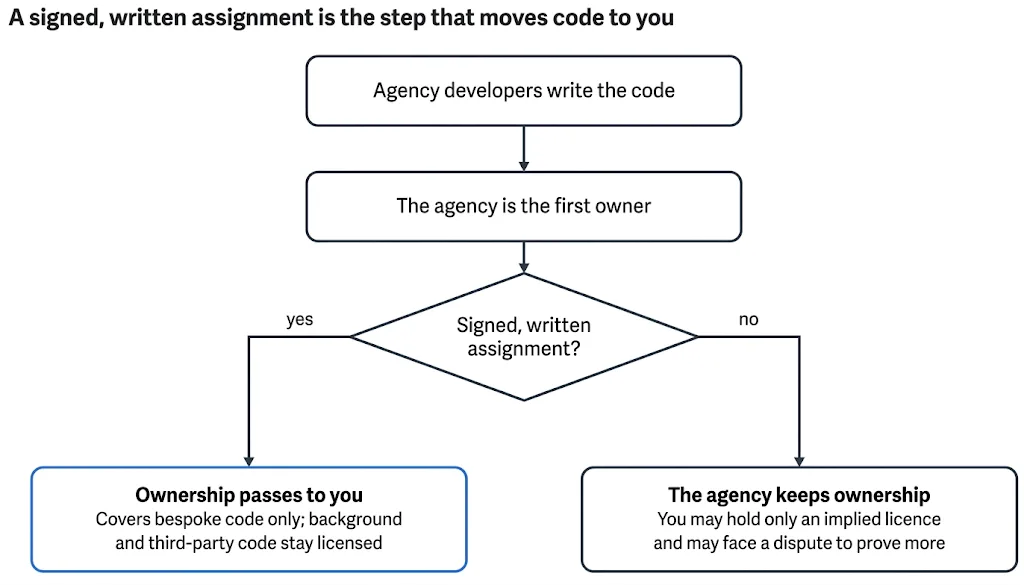
Not automatically you. In the UK, paying a software development agency does not transfer copyright in the code it writes. The agency's developers are usually its employees, so the agency is the first owner. The code becomes yours when your contract says so in a signed, written assignment.
That surprises people because it works differently from buying a laptop. You are buying a service, and the legal rights in the output stay with whoever created it until someone transfers them.
Who wrote the code | Default owner | What moves ownership to you |
Your own employee, doing their job | You, as employer | Nothing further |
A freelancer or contractor | The freelancer | A signed written assignment |
An agency's own staff | The agency | A signed written assignment |
An agency's subcontractors | The subcontractor | Assignment to the agency, then to you |
What UK Law Actually Says
Five points do most of the work.
Copyright starts with the author
Software is protected as a literary work under the Copyright, Designs and Patents Act 1988 (CDPA), and the author is the first owner. Nothing needs registering. If your employee wrote the code as part of their job, you own it as the employer. If someone outside your payroll wrote it, they do.
Paying for the work does not buy the copyright
In Griggs Group v Evans, the Court of Appeal endorsed a summary of the rules: the contractor keeps the copyright unless the contract says otherwise, expressly or by implication, and commissioning alone is not enough. A silent contract may leave you with only a licence, although a court will sometimes find that the client holds the beneficial ownership. Asking a judge to fill the gaps in your contract is an expensive way to learn who owns your platform.
An assignment must be written and signed
Under section 90(3) of the CDPA, an assignment of copyright is not effective unless it is in writing and signed by or on behalf of the assignor. A handshake or a paid invoice does not qualify.
Labels do not decide ownership
In Sprint Electric v Buyer's Dream, a programmer who worked through his own company was found to be an employee in reality, so the business he served owned his source code under section 11(2). Substance beats paperwork, in both directions.
Moral rights rarely matter for code
Moral rights are personal. They can be waived but not assigned, and the CDPA excludes computer programs from the right to object to derogatory treatment. Your contract should still waive them for designs, documents and written content.