What a software development agency actually does
A software development agency is an external team that plans, designs, builds, launches, and maintains software on your behalf. Think of it as hiring a specialist crew instead of employing every role yourself: business analyst, designer, developers, testers, DevOps engineer, and project manager. The best ones also tell you what not to build.
That advice matters, because custom software development is not always the answer. Use this comparison to decide.
Situation | Off-the-shelf tool | Custom software |
Standard process, such as payroll or email | Usually the best choice | Rarely worth the cost |
Unique workflow or pricing logic | Forces workarounds | Built around how you work |
Many systems that must talk to each other | Limited connectors | Tailored integrations and APIs |
Speed to first use | Days | Weeks to months |
Ownership and control | The vendor sets the roadmap | You set the roadmap, and should own the code |
A simple rule of thumb: if a packaged product covers most of what you need, configure it. If your competitive edge lives in how you operate, build it.
Eight checks before you shortlist a software development agency
1. Proof that matches your problem
Ask for case studies that state the problem, the build, and the outcome, not just screenshots. Suppose you need an energy comparison platform with live supplier data, quote logic, and secure contracts. A software development agency that has shipped something similar will raise those details before you do.
Tip: ask for a reference call with a client whose project resembles yours.
2. A real discovery phase
Be wary of a firm price after one phone call. Sound agencies run discovery first: workshops, user stories, architecture, and a written scope with acceptance criteria. That document is what protects your budget later.
3. Senior people you can actually meet
Ask who will write the code, and whether you can meet the tech lead before signing. Some firms pitch with senior talent and then staff the project with juniors or subcontractors.
4. Security and UK compliance
If the software touches personal data, look for UK GDPR competence and independent proof, such as Cyber Essentials Plus or ISO 27001 certification. Ask where data will be hosted and who can access it.
Tip: ask to see the certificates and check the expiry dates.
5. A pricing model that fits your roadmap
Model | Best for | Watch out for |
Fixed price | A clearly defined build | Change requests that inflate the bill |
Time and materials | A scope that will evolve | Cost drift without firm reporting |
Retainer | Ongoing features and AI tuning | Paying for capacity you do not use |
Our guide to retainer versus project-based engagements explains how to choose between them.
6. Clear ownership and an exit route
Your contract should confirm that you own the source code on completion, list any third-party components, and describe handover. If leaving a software development agency would mean losing your software, that is lock-in, not partnership.
7. Post-launch support with response times
Software needs security patches, dependency updates, and tweaks based on real user behaviour. Ask what support is included, how fast the software development agency responds, and who answers when something breaks at 8 am on a Monday.
Tip: agree the support terms in writing before the build begins.
8. Communication you can measure
Look for a named project manager, fortnightly demos and shared access to the task board. If you cannot see progress, you cannot steer it. Our longer piece on what nobody tells you before hiring a software development agency covers hidden costs and contract traps in more depth.
How to test AI integration and AI chatbot skills
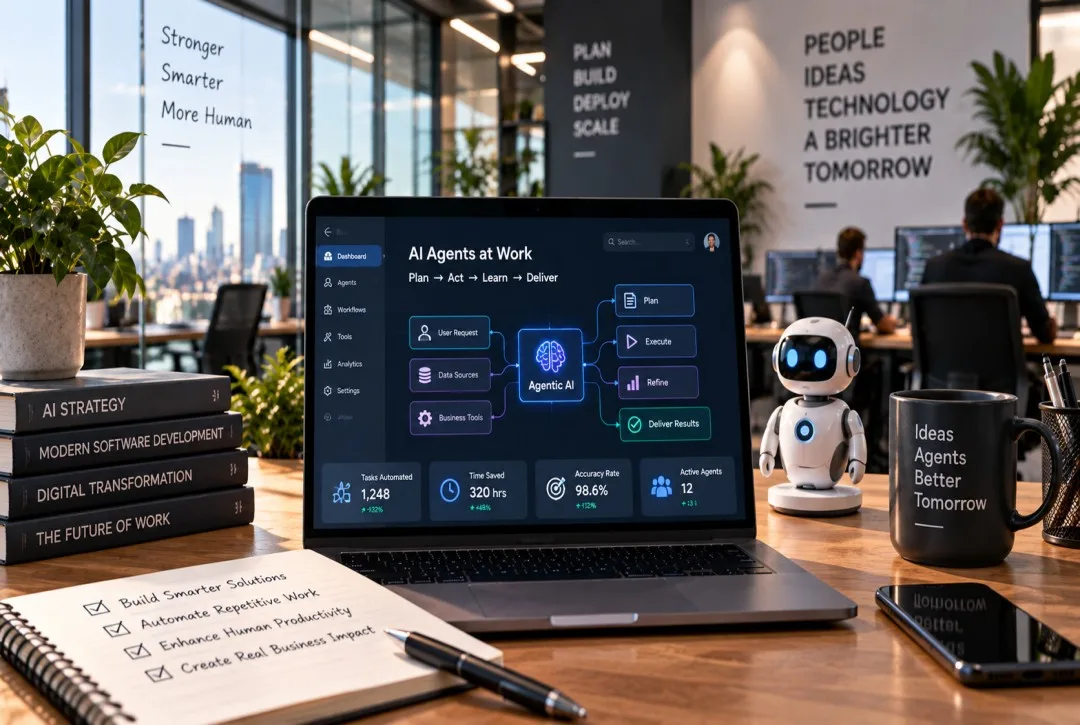
Almost every software development agency now claims AI expertise. Fewer can prove it. AI integration means building machine learning or language models into your software so it can predict, classify, summarise, or act. AI chatbots are one common form: conversational tools that answer questions, qualify leads, or handle routine support.
Know which type of chatbot you are buying
Type | How it works | Good for | Trade-off |
Rule-based | Fixed scripts and decision trees | Simple FAQs and routing | Breaks on unexpected questions |
LLM-powered (large language model) | Understands natural language and draws on your content | Support and sales queries | Needs guardrails and monitoring |
Agentic | Takes actions across your systems | Bookings, quotes and multi-step tasks | Higher build and governance effort |
Five questions that expose AI window-dressing
Which model would you use, and why that one over the alternatives?
How will you stop the chatbot from giving wrong or inappropriate answers?
What happens when it cannot answer, and where does the customer go next?
How do you measure accuracy after launch, and who retrains it?
Which of our systems will it connect to, and how is the data protected?
A software development agency with real experience answers with specifics. One without will retreat into buzzwords. Also check the data work underneath. AI projects rarely fail because of a clever algorithm. They fail because of messy data.
Start with one narrow use case, such as a chatbot that handles your ten most common customer questions. Prove the value, then widen it. Agencies that begin with a data and AI maturity assessment, as our AI model development service does, make that first step much easier.
Red flags to walk away from
Red flag | Why it matters | What to do |
Firm price after one call | They are guessing at your scope | Ask for a discovery phase first |
Only mock-ups, no live examples | Delivery is unproven | Request a live demo and a reference call |
Vague answers about AI | Buzzwords without skills | Use the five AI questions above |
Code stays with the agency | Lock-in and higher switching costs | Get source code assignment in writing |
No support plan | You inherit the risk after launch | Agree service levels before signing |
A complex build promised in weeks | Rushed work creates technical debt | Ask for a phased plan with demos |
One red flag deserves a conversation. Several deserve a different software development agency.
Score agencies side by side
Gut feel is unreliable when every pitch sounds confident. Send each shortlisted software development agency the same brief, then score them from 1 to 5 on each criterion. Multiply by the weighting and add up the results.
Criterion | What a 5 out of 5 looks like | Weighting |
Relevant proof and references | Similar projects, live demos and reachable clients | 20% |
Discovery and scoping | A written scope with acceptance criteria before pricing | 15% |
Security and compliance | UK GDPR competence plus certifications you can verify | 15% |
AI and technical depth | Specific answers on models, data and monitoring | 15% |
Communication and team access | A named lead, fortnightly demos and a shared task board | 15% |
Ownership, support and exit terms | Code ownership, service levels and handover in writing | 10% |
Price transparency | An itemised quote and a clear change-control process | 10% |
Adjust the weightings to suit your project. A healthcare product might lift security to 25%, while a quick marketing tool might care more about speed.
A six-step process you can start this week

Here is how it looks in practice. A regional distributor wants an AI chatbot to answer order queries. It writes a one-page brief naming the problem, the users, and a budget range (step 1), shortlists three agencies (step 2), and sends each the same brief, then scores the replies with the table above (step 3). The winner runs a six-week paid pilot on one narrow use case, order-status questions (step 4). The share of queries resolved without a human decides whether to proceed, so the distributor signs a contract with clear ownership, service levels, and exit terms (step 5) and builds in fortnightly cycles (step 6). The budget follows evidence, not enthusiasm.
Note: This is an illustrative example, not a client case study.