If your enquiries dipped or your rankings bounced around between late September and early October, you are not imagining it. Google released its September 2026 spam update on 24 September and finished rolling it out on 8 October, after almost 14 days. It was the fourth Google spam update of the year, and the slowest of them.
So what should you do now? Rewriting every page in a panic is the worst option. A top SEO company in UK works through a calm, evidence-led order of checks, and that order matters more than any single fix.
In this article, we share what a top SEO company in UK checks first: technical SEO, content strategy, local SEO and your link profile.
What Google has actually said about the September 2026 spam update
Let us separate confirmed facts from guesswork, because there is plenty of the latter online.
2026 spam update | How long the rollout took |
March | 19 hours 30 minutes |
June | 2 days 1 hour |
August | 2 days 16 hours |
September | 13 days 16 hours |
What is confirmed
Google released the update on 24 September 2026 and said it applies globally, in every language. The Google Search Status Dashboard shows it complete on 8 October. As the table shows, it was the fourth spam update this year and the slowest by a wide margin (Search Engine Journal).
What is not confirmed
Google has not said which spam policy or tactic the update targeted. It followed Google's 28 August change to its site reputation policy, but Google has not linked the two. Anyone who claims to know exactly what it targeted is guessing.
One point matters for UK readers. From 30 August, site reputation manual actions no longer affect results shown in the European Economic Area. The UK sits outside the EEA, so for UK searchers the policy applies as before.
Why recovery takes time
Google's spam updates guidance says a compliant site may improve once its automated systems learn, over a period of months, that it follows the spam policies. So fix things calmly, then give the changes time to be noticed.
What a top SEO company in UK checks first
A top SEO company in UK does not start by editing pages. It starts by asking whether the update is the cause at all. Google's guide to debugging traffic drops lists seasonality, reporting glitches and technical faults alongside algorithm and spam issues, and it advises against radical changes to pages that already perform well.
So, it works in a fixed order, from the cheapest and most certain checks to the slowest and most judgemental.
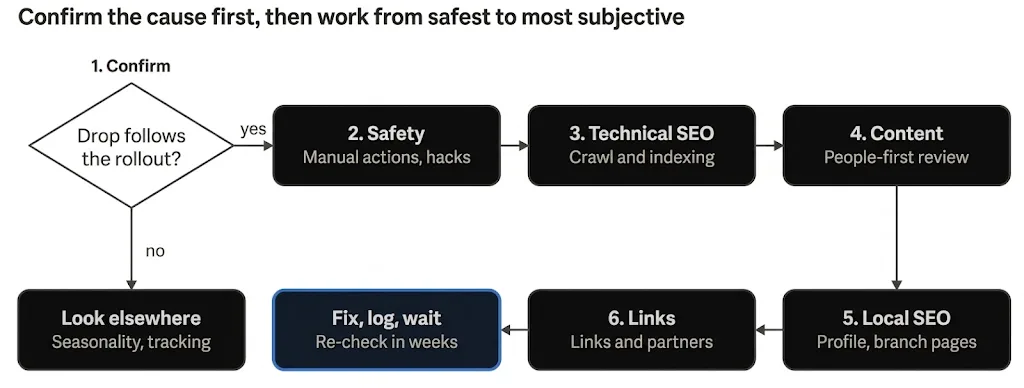
If the drop does not follow the rollout dates, it looks elsewhere before touching a single page.
Step | Question it answers | Where we look |
1. Confirm | Did the drop follow the rollout dates? | Search Console, 16 months, year on year |
2. Safety | Is there a manual action, hack or injected spam? | Manual actions and Security issues reports |
3. Technical | Can Google crawl the right pages and see what users see? | Crawl stats, page indexing, full site crawl |
4. Content | Was each page made for people first? | Page-by-page review against Google's helpful content questions |
5. Local | Are our location signals honest and consistent? | Google Business Profile, location pages, citations |
6. Links | Are links and third-party content earned and labelled? | Backlink audit, sponsored link review |
The next sections take each step in turn, with practical examples.