
Last year, a business owner we will call Sara (a composite, not a real client) sent the same two-page brief to four software development agencies. The quotes came back at £18,000, £32,000, £61,000 and £85,000. Sara was baffled. She had asked for the same thing each time. In fact, she had not, because the brief left so much open that each agency filled the gaps with its own assumptions.
That gap is the reason most quotes differ so much. A software development agency can only price what it understands, and a vague brief forces it to guess. The good news is that a clear brief is within reach for any business, whether you are commissioning a custom platform, an AI integration or a customer chatbot. This guide shows you what to include, how to describe the problem without over-specifying the solution, and how to brief AI work so that quotes can be compared fairly.
Why Quotes Vary So Much
Software projects have a long record of going wrong, and unclear requirements are a recurring cause. The Standish Group’s 1995 CHAOS report, one of the most cited early studies of software projects, surveyed 365 IT executives covering 8,380 applications. Only 16.2% of projects succeeded in the sense of arriving on time, on budget and with all features. More than half were challenged, and 31.1% were cancelled during development.
The same report named the causes. Among cancelled projects, incomplete requirements (13.1%), lack of user involvement (12.4%) and changing requirements (8.7%) were the leading reasons. Those are the three things a good brief is designed to address.
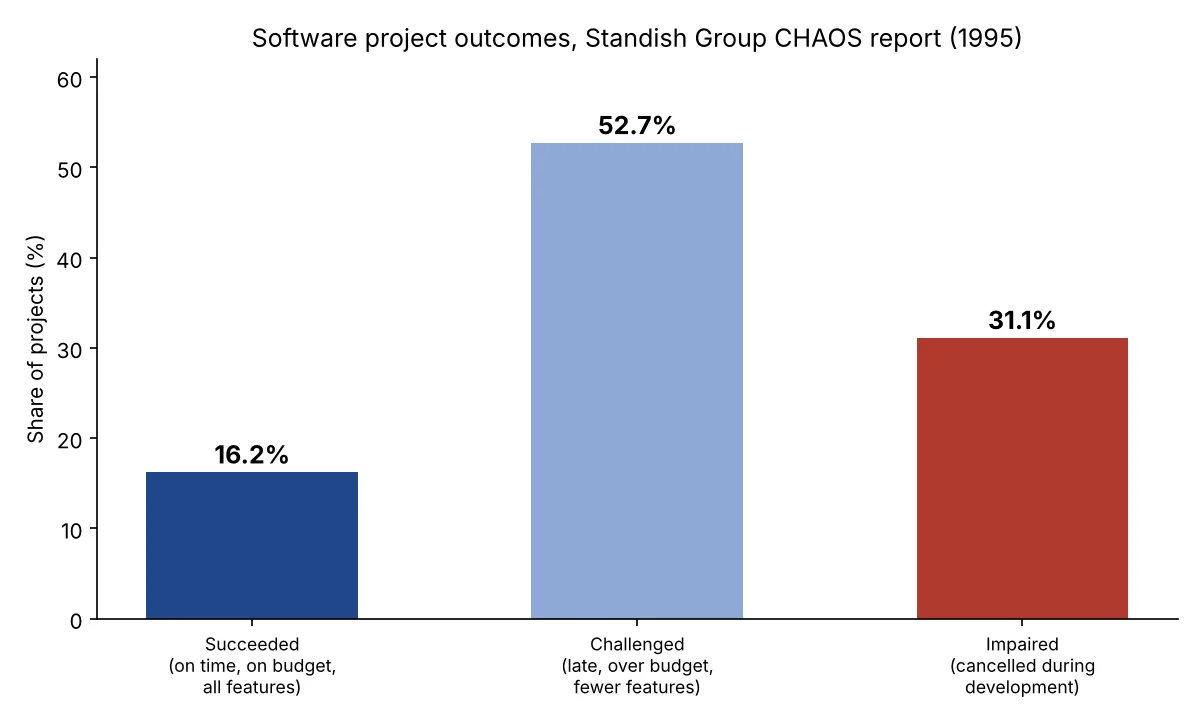
Figure 1: Software project outcomes, Standish Group CHAOS report (1995). The data is old, but the causes it identifies still appear in agency briefs today.
Quotes diverge for the same reason. When a brief is silent on performance, security, integrations or what happens after launch, each agency makes its own assumption. The cheapest quote may have quietly excluded half the work, and the most expensive may have padded for risk you never needed to carry.
The Ten Sections Every Brief Needs
A useful brief does not need to be long. For most projects, a handful of well-chosen sections will do. The table below sets out what each section should contain and why agencies need it.
Brief section | What to include | Why the agency needs it |
|---|---|---|
1. Purpose | The problem or opportunity, in your words | Lets the agency suggest the right solution, not just the one you described |
2. Scope in and out | What is included, and what is deliberately excluded or left for later | Stops two quotes being priced for different projects |
3. Users | Each type of user, their needs and how technical they are | Shapes the design and the amount of support needed |
4. Functional requirements | The features, with specific limits such as file types and volumes | Makes the work specific enough to estimate |
5. Non-functional requirements | Speed, security, accessibility, uptime and expected load | Often left out, and a common source of later rework |
6. Integrations | Each system to connect, the data it sends and how often | Integrations are a frequent source of hidden cost |
7. Constraints | Hosting preferences, regulation, data location and internal IT policy | Rules out approaches you cannot use |
8. Budget range | A realistic range, not a hidden ceiling | Lets the agency propose something suitable |
9. Timeline | Whether the launch date is fixed, and any key milestones | Affects team size and what can be delivered first |
10. Acceptance criteria | Measurable conditions for “done” | Defines what you are paying for before work starts |
Table 1: A ten-section brief structure, adapted from UK web agency briefing guidance.
Describe the Problem, Not the Solution
The most common mistake is to write the solution in detail and leave out the problem. A brief that says “build a chatbot with three buttons and a live chat handover” tells the agency what you want, but not why. A brief that says “we answer the same twenty questions by phone every day, and a third of enquiries arrive out of hours” tells the agency what to solve. The second version lets a good agency propose something better, and it makes quotes easier to compare because everyone is working from the same problem.
Before you write a word of the brief, answer three questions in plain language. What problem are we solving? Who is affected by it? How will we know when it is solved? If you cannot answer them, the project is not ready to quote, and a discovery phase may be the most useful first step.
Separate Must-Haves From Nice-to-Haves
Every stakeholder thinks their feature is a priority. Without a ranking, the agency has to price everything, and the quote becomes large and hard to compare. The MoSCoW method, which sorts features into Must, Should, Could and Won’t, solves this. It also tells you in advance what gets cut if time or budget runs short.
Priority | Meaning | Example for an online booking platform |
|---|---|---|
Must | The product does not work without it | Customers can book and pay online |
Should | Important, but the product can launch without it | SMS reminders for appointments |
Could | Useful if time and budget allow | Loyalty points for repeat customers |
Won’t (this phase) | Agreed to be out of scope for now | Support for multiple languages |
Table 2: Using MoSCoW prioritisation in a software brief.
As a rule of thumb, aim for Must-Haves to make up no more than about 60% of the expected effort. That leaves room for surprises. If every feature is a Must, the brief is telling the agency that nothing can be cut, and it will price accordingly.
How to Brief AI Integration and Chatbot Projects
AI work brings a set of questions that a standard brief does not cover. What should the system answer, and what should it pass to a person? Which data will it use? How will you know it is working? These questions shape the cost far more than the choice of tool.
GSS Tech Solutions’ AI model development service, for example, covers chatbots, natural language processing and integration with existing systems. Its ten-stage process starts with understanding business needs and moves through data preparation, integration, testing and ongoing monitoring. A brief that answers the questions below will let any agency follow a similar process with confidence.
Area | What to specify | Example |
|---|---|---|
Purpose | The questions the system should answer, and those it must hand to a person | Answer opening hours, prices and booking changes. Hand complaints to the front-desk team |
Channels | Where it will appear | Website chat and WhatsApp, not phone calls in the first phase |
Systems to connect | Each system, the data direction and how often it syncs | Read appointments from the calendar and write new leads to the CRM |
Knowledge source | Where answers come from, and who keeps them current | Policy documents and product list, updated by the operations manager |
Data and privacy | What personal data is handled, how long it is kept and where | Names and contact details, kept for 12 months, UK-hosted, compliant with UK GDPR |
Accuracy and safety | What happens when the system is unsure, and who approves answers | Answers with low confidence are routed to a person |
Success measures | How you will judge the result | Share of enquiries resolved without a person, and average response time |
Table 3: What to specify in an AI integration or chatbot brief.
Be as specific as you can about integrations, because each one adds effort. A chatbot that answers questions from a document is a very different job from one that books appointments, takes payment and updates a CRM. If you cannot list the systems yet, say so, and ask the agency to treat integration as a separate discovery step.
Budgets, Timelines and Brief Length
Disclosing a budget range feels risky, but it usually helps. It tells the agency whether to propose a lean first version or a fuller build, and it stops both sides wasting time on proposals that cannot be funded. Be direct about what matters most. If you care about value more than the lowest price, say so, and explain what you mean by value.
Brief length should match the size of the project. One UK web agency’s guidance suggests two to four pages for projects under £20,000, five to ten pages for projects between £20,000 and £100,000, and fifteen or more pages above £100,000. Treat these as a practical guide, not a standard.
Project size | Suggested brief length | What to prioritise |
|---|---|---|
Under £20,000 | Two to four pages | Purpose, scope, Must-Haves and budget range |
£20,000 to £100,000 | Five to ten pages | Adds integrations, non-functional requirements and acceptance criteria |
Over £100,000 | Fifteen pages or more | Adds detailed constraints, data protection, phasing and governance |
Table 4: Suggested brief length by project size (guidance from a UK web agency).
Chatbot pricing is a good example of why ranges need context. One UK chatbot developer publishes indicative tiers from £2,500 for a simple FAQ bot to £40,000 and above for enterprise work, but its figures are not linked to named sources. Use published ranges to frame your conversation, and rely on a written quote to set your actual budget.
Non-Functional Requirements: The Part Everyone Forgets
Performance, security and accessibility are the requirements most briefs leave out, and they are often the most expensive to fix later. A page that takes several seconds to load on a phone, or a form that fails screen readers, can cost far more to correct after launch than to specify before it. State your expectations in measurable terms. For example, “pages load within three seconds on a mobile connection”, “meets WCAG 2.2 AA accessibility standards” or “supports 500 concurrent users”.
What a Good Quote Looks Like
Once the brief is written, compare quotes on what they cover, not only on the total. A useful proposal explains its assumptions, lists exclusions, breaks the work into phases and states what happens after launch. The table below sets out what to look for, and what should make you cautious.
Quote element | Good sign | Caution sign |
|---|---|---|
Assumptions | Listed clearly, with a way to confirm them | None stated, or “to be confirmed later” for everything |
Scope | Maps to your Must-Haves, with exclusions named | Vague, with no reference to your priorities |
Integrations | Each one priced or estimated separately | Bundled into a single lump sum |
Timeline | Milestones tied to deliverables | One end date with no checkpoints |
Post-launch | Support, hosting and maintenance costs stated | Silent on what happens after go-live |
Acceptance | Measurable criteria for each phase | Sign-off described as “when you are happy” |
Table 5: How to read a software development quote.
Ask every agency to explain the difference between its quote and the others. A good agency can tell you exactly where its estimate comes from. If it cannot, the number is more of a guess than a plan.
Frequently Asked Questions
Do I need a full specification before I contact a software development agency?
No. You need a clear purpose, a rough view of users and must-have features, and a budget range. The agency can help you refine the rest. If the project is complex or unclear, ask for a short discovery phase, which is often a sensible way to produce a detailed brief before committing to build.
Should I share my budget with the agency?
Yes, as a range. It helps the agency design a suitable solution, and it protects you from proposals that are far too large or too small for what you can fund. You can share it in confidence and ask the agency to work within it.
How to brief AI chatbots without technical knowledge?
Describe the conversations you want to handle, the questions it must pass to a person, and the systems it needs to read from or write to. You do not need to know which AI model is used. Ask the agency to explain its approach to data, accuracy and privacy, and to set out how success will be measured.
What if the requirements change during the project?
They will, at least in part. Agree how changes are raised, estimated and approved before work starts. A change process protects both sides, and it stops small requests turning into quiet scope creep.
Final Words
A software development agency can only quote accurately on what it understands. A clear brief describes the problem, sets priorities, names the systems involved, states measurable standards and gives a realistic budget range. It does not need to be long or technical. It needs to be honest about what matters most.
Write the brief before you start comparing agencies, and use the same brief for every proposal. You will get quotes you can actually compare, and you will spend less time on surprises later.
Need Help Shaping Your Brief?
At GSS Tech Solutions, we help UK businesses turn rough ideas into briefs we can quote on with confidence. Our custom software development and AI model development teams cover discovery, integration with existing systems and chatbot projects, from first conversation to launch and ongoing support. Share your requirements through our contact form, and we will talk through what you need before you commit to anything.
Call +44 203 599 8122 or visit gsstechsolutions.co.uk to start the conversation.